



Pharmacovigilance in Germany and Europe

Why are side effects recorded in Germany?
In the past, side effects in Germany were increasingly collected in a decentralized manner. This means that a wide range of healthcare stakeholders, i.e., patients, healthcare professionals and authorities, reported side effects through a wide variety of channels.
Today, the trend is moving in a different direction – reporting is increasingly centralized and Europe-wide, which is significantly more efficient. For this reason, the Bundesverband der Pharmazeutischen Industrie e.V. (BPI) predicted in 2016 that the number of reportable side effect cases would rise to 500,000 per year.[1] The reports from all parties are collected and processed centrally by the European Medicines Agency (EMA) alone.
In fact, recording and monitoring side effects continues to make an essential contribution to drug safety even after marketing authorization.[2] Some very rare side effects, for example, only come to light through monitoring across the broad population. It also allows for a more efficient and accurate benefit-risk analysis.
What is the legal basis for monitoring medicinal products?
In Germany, pharmaceutical manufacturers with authorized drugs are required under Section 63b of the German Medicinal Products Act (AMG) to establish a pharmacovigilance system, i.e., a system for the systematic monitoring of their medicinal products.
Doctors and pharmacists are also obliged to report adverse drug reactions to their respective drug commission once they become aware of them. Patients can also submit reports, but they are not obliged to do so, even in the case of unexpected serious side effects.
Yet patients are the most powerful source of information and are actually ideally suited to fill pharmaceutical manufacturers' pharmacovigilance systems with valuable data.
What reporting channels for side effects are there?
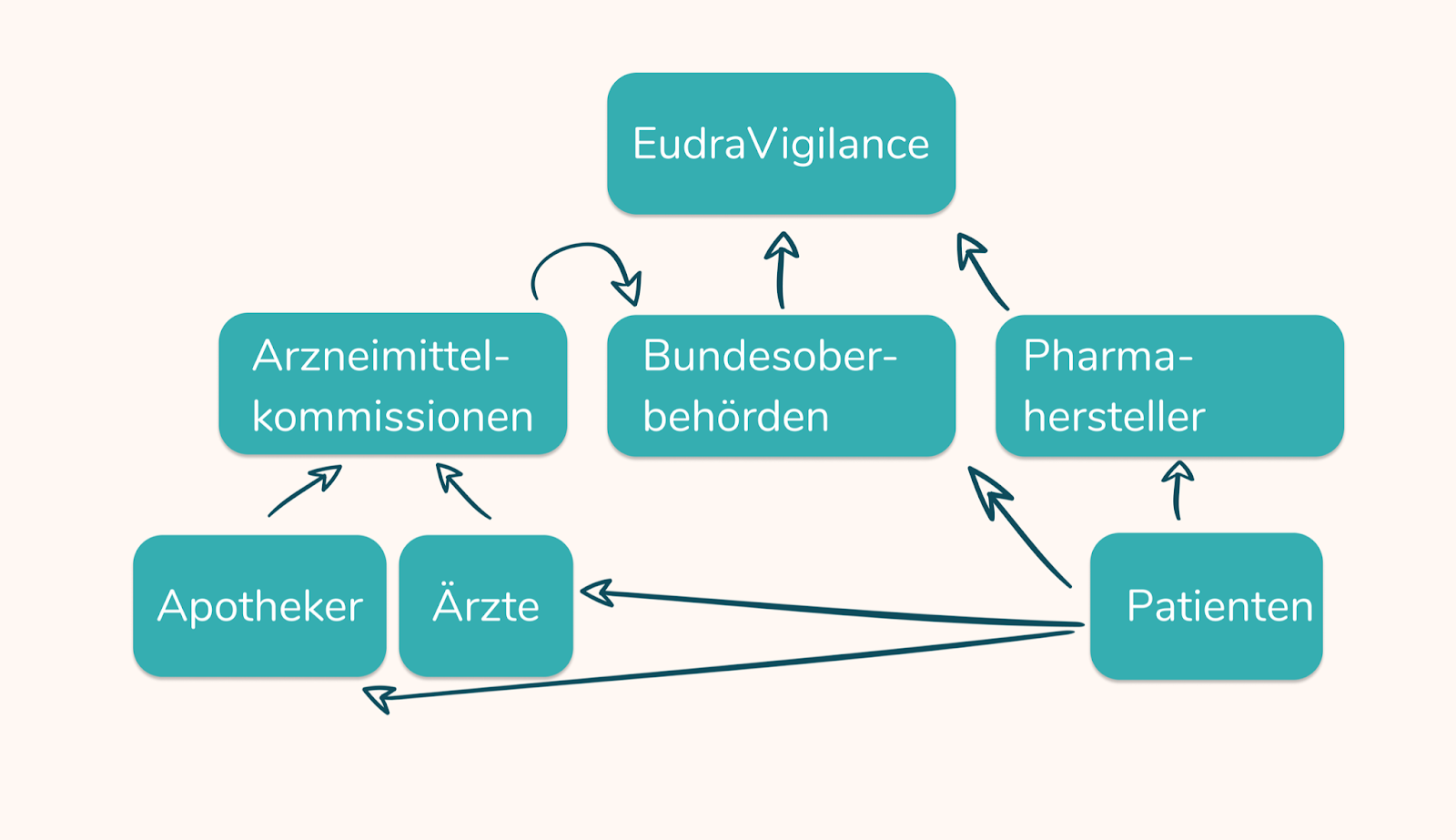
A look at the existing reporting system in Germany shows the variety of options, which can sometimes be very confusing for patients and reporters: according to the guidelines of their respective commissions, doctors and pharmacists should first report adverse drug reactions to their respective drug commission. For doctors, this is the Arzneimittelkommission der Deutschen Ärzteschaft (AkdÄ); for pharmacists, it is the Arzneimittelkommission der Deutschen Apotheker (AMK).
The two drug commissions then forward the collected reports to the federal higher authorities, i.e., the Paul-Ehrlich-Institut (PEI) and the Bundesinstitut für Arzneimittel und Medizinprodukte (BfArM). From there, complete reports are forwarded to the EMA's European pharmacovigilance system, called EudraVigilance.
However, it has become established practice for doctors and pharmacists to report side effects directly to pharmaceutical manufacturers from time to time. This is because a report is often accompanied by medical questions or product complaints.
In addition to these reports, pharmaceutical manufacturers also receive reports from patients themselves and forward them to the EMA via their pharmacovigilance system. There, the reports are in turn entered into EudraVigilance.
As the graphic shows, patients can report directly to all institutions, i.e., to pharmaceutical manufacturers, to doctors and pharmacists, and to the federal higher authorities. With these diverse reporting chains, which are often confusing for users, it is easy to see how duplicate reports or even the loss of individual reports can occur.
In addition, submitting a report is not necessarily a clearly structured process for the average citizen. For a report to be considered complete, it must fully meet four criteria[3]:
-
- One or more suspected side effects.
- One or more suspected substances or medicinal products.
- One or more clearly identifiable patients
- One or more clearly identifiable reporters
Why does XO Life collect patient data on side effects?
As digitalization in healthcare increasingly calls for multilateral communication on an equal footing, comprehensive access to health information, and trust and security, we have made it our mission to support this development. To this end, we have built a multidirectional communication platform through which patients can report adverse drug reactions quickly, easily and in a structured way.
The reports are forwarded to the respective marketing authorization holder in pseudonymized form, i.e., without revealing the personal identity of the reporters. Manufacturers, in turn, can send digital queries, known as follow-ups, to patients with just a few clicks, and patients can answer them directly on their smartphone or laptop.
What are the advantages of XO Life's platform?
Our platform has been proven to lead to a 10-fold higher response rate from patients. Complete reports can usually be closed after 72 hours, which represents a considerable time improvement over the current system. A look at the current figures[4] on adverse drug reaction reports shows that, of more than 60,000 reports received in 2020, nearly 30% were processed through XO Life's platform. However, the total number of adverse drug reaction reports is declining; in 2018, for example, there were still around 80,000 reports.[5] This is certainly partly due to the decline in doctor visits during the COVID-19 pandemic. Healthcare professionals recorded around 15% fewer reports during this period.
Interestingly, however, direct patient reports increased by 36% over the same period.[4;5] This clearly underlines the trend of so-called patient empowerment, in which patients are increasingly taking their health matters into their own hands. To do so, patients use precisely such digital, user-centered tools for direct communication between patients and pharmaceutical manufacturers. XO Life's communication platform is a typical example of such a digital tool.
In this way, we want to shape the pharmacovigilance of the future through digitalization and automation.
Our goal is to make clearly structured data sets accessible so that pharmaceutical manufacturers can evaluate safety-critical data quickly and efficiently. Of course, our highest priority is to carry out this work in compliance with all GDPR rules.
Conclusion
Almost 100 pharmaceutical manufacturers are already registered on XO Life's real-world evidence platform today. 50% of them also use the option of sending digital follow-up queries to patients – and the number is rising sharply. This clearly shows that pharmaceutical manufacturers have a strong interest in a simple reporting and communication platform to get in touch with their customers.
This not only benefits drug safety in general but also makes work easier for the pharmacovigilance departments of many pharmaceutical manufacturers. XO Life helps patients and pharmaceutical companies get in direct contact in order to create an all-encompassing reporting and communication platform with data from real-world care.
Sources:
[1] Bundesverband der Pharmazeutischen Industrie e. V. & Thurisch, B. (2016). Erfassung von Nebenwirkungsberichten Herausforderungen für die pharmazeutische Industrie [Lecture slides]. Bfarm.de. https://www.bfarm.de/SharedDocs/Downloads/DE/Service/Termine-und-Veranstaltungen/dialogveranstaltungen/dialog_2016/160226/03_Folien_Thurisch.pdf?__blob=publicationFile&v=2
[2] Kommas, E., Lex, D., Huber, M. & Paeschke, N. (2019). Verdachtsfälle melden. DAZ.online. https://www.deutsche-apotheker-zeitung.de/daz-az/2019/daz-37-2019/verdachtsfaelle-melden
[3] European Medicines Agency. (2017). Guideline on good pharmacovigilance practices (GVP). ema.europa.eu. https://www.ema.europa.eu/en/documents/regulatory-procedural-guideline/guideline-good-pharmacovigilance-practices-gvp-module-vi-collection-management-submission-reports_en.pdf Last accessed: May 19, 2021
[4] Bundesinstitut für Arzneimittel und Medizinprodukte. (2021). Nebenwirkungsmeldungen Sachstand BfArM. 88. Routinesitzung.
[5] Bundesinstitut für Arzneimittel und Medizinprodukte. (2019). Nebenwirkungsmeldungen Sachstand BfArM. 84. Routinesitzung.
