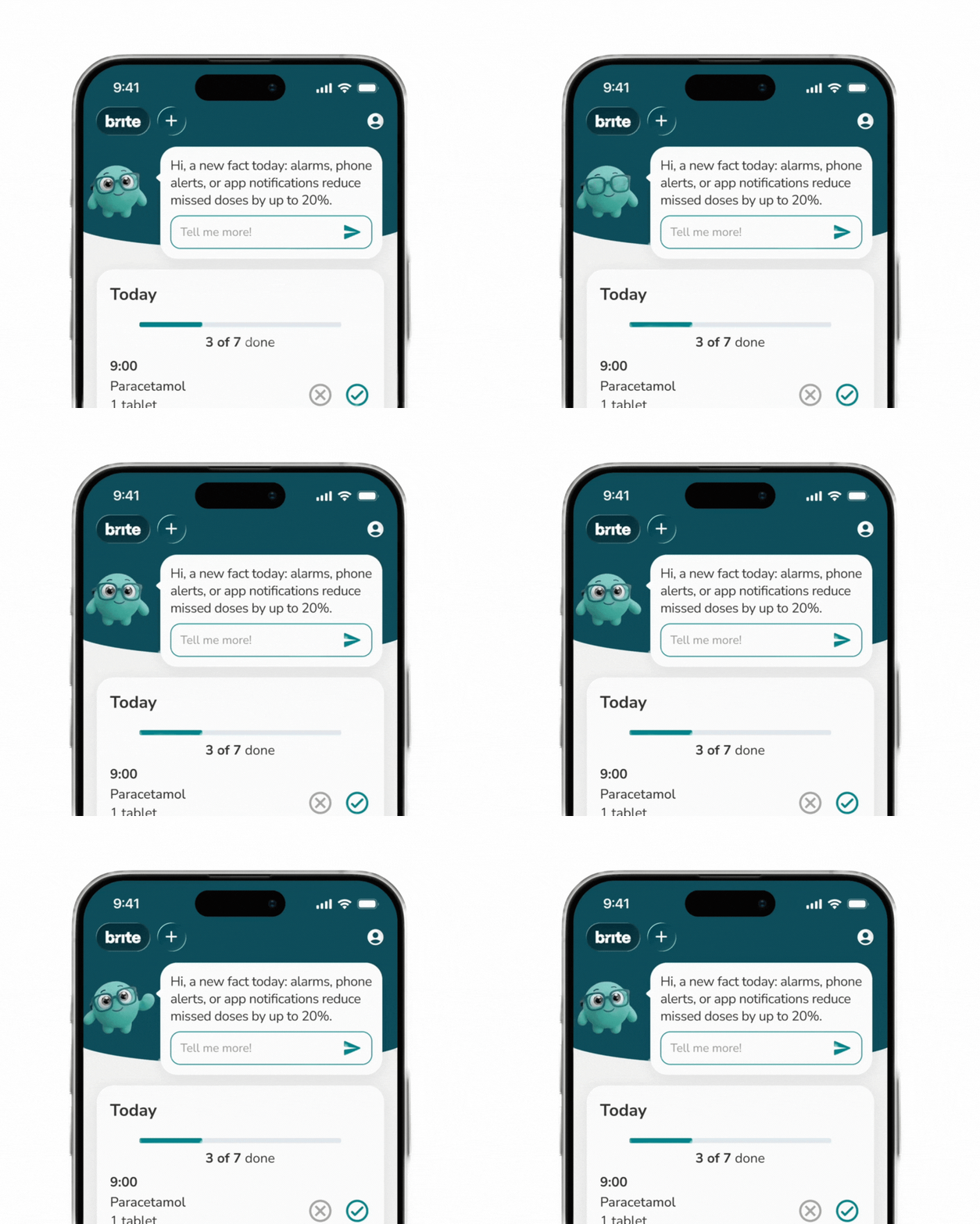
I finally understand my therapy. The app reminds me, answers my questions — and I don't feel alone with it anymore.
Diazepam
Diazepam: Dependence and Fall Risk — Why Short, Low-Dose Use Is Safer
Diazepam is one of the best-known benzodiazepines and works quickly against anxiety, tension and muscle spasms. Because diazepam and its active breakdown product nordazepam stay in the body for days, it builds up with regular use – especially in older age, with consequences for steadiness on your feet, memory and the risk of dependence. According to the SmPC, the rule is therefore: as low a dose and as short a course as possible.
Long-acting benzodiazepine; a sedative (tranquilliser) with anxiety-relieving, muscle-relaxing and anticonvulsant effects
Dosage forms
Tablets (including 2, 5 and 10 mg), drops, solution for injection, rectal tubes (a solution given into the rectum) for emergencies
Half-life
20 to 100 hours according to the SmPC; the active breakdown product nordazepam 30 to 100 hours. In older age and with liver disease, towards the upper end
Maximum daily dose
For outpatients, according to the SmPC, usually 5 to 10 mg; higher doses (up to 60 mg) generally only in hospital. For older people, about half. Your individual dose is set by the practice
Onset of effect
Peak blood levels about one hour after taking a tablet; a stable level (steady state) only after 5 to 15 days of daily use
Prescription status
Prescription-only medicine
Notable feature
Builds up with daily use; dependence possible even at usual doses; potentially inappropriate for older people according to the PRISCUS list
Table scrolls to the right
2. How it works: fast calm with a long after-effect
Like lorazepam (Tavor), diazepam belongs to the benzodiazepines. Both act at the same site and cause dependence in the same way — the article on lorazepam describes this basic mechanism in detail. This article is about what makes diazepam special: its very long stay in the body and what that means for falls, memory and stopping.
In the brain, GABA (gamma-aminobutyric acid) is the most important inhibitory messenger substance. Diazepam docks onto a binding site of its own on the GABA-A receptor and strengthens the effect of GABA. Nerve cells become harder to excite. Depending on the brain region, this shows up as relief from anxiety, calming, drowsiness, muscle relaxation or protection against seizures.¹
Strengths: the effect sets in quickly and is reliable. That is why diazepam is useful in acute situations — for severe anxiety or agitation, before procedures, for muscle spasms and as an emergency medicine for seizures.
Weaknesses: the brake works everywhere, not only where it is wanted. Hence drowsiness, slowed reactions, unsteadiness and memory gaps. The brain also adapts to the constant brake — the basis for tolerance and dependence.
Why the half-life matters so much
Diazepam is broken down in the liver to nordazepam (N-desmethyldiazepam), which is itself active and stays in the body even longer. According to the SmPC, the half-lives of both substances are each up to 100 hours.¹ If you take diazepam every day, each new tablet adds to what is left of the previous one. The level rises over one to two weeks before it levels off. This is why many people only notice after a few days that they feel groggier in the morning than at the start — even though nothing about the dose has changed.
An honest assessment. The long duration of action is both a blessing and a curse. It provides an even level without gaps in effect between doses, and it makes withdrawal symptoms milder and delayed when tapering. At the same time, the sedating effect lasts long after it is no longer needed — the next morning, when driving, on the way to the toilet at night.
3. Dosing: as low and as short as possible
The following information reflects the SmPC and is not a dosing instruction. The dose and duration are set by the treating practice — depending on the reason for treatment, your age, weight, other conditions and how you respond.¹
Anxiety, tension and agitation (outpatients): according to the SmPC, treatment usually starts with 5 mg a day, given as one or two doses with the emphasis on the evening; if necessary, it is increased to 10 mg. Higher doses are rarely needed and generally belong in hospital.
Severe states (in hospital): under medical supervision, 30 to 60 mg a day can be used, reached step by step.
Increased muscle tone: 10 to 20 mg a day at first, 5 to 10 mg to continue.
Before surgery: single doses the evening before or before the procedure, set by the anaesthesia team.
Older and frail people, liver, kidney or respiratory impairment: usually half the dose — according to the SmPC, 2.5 mg at first and at most 5 mg a day.
Just as important as the dose is the duration. According to the SmPC, treatment for acute complaints should be limited to single doses or a few days. After two weeks of daily use, the practice should check whether it is still needed at all, and according to the SmPC, use should not exceed four weeks.¹
Clarify this before the first prescription. Ask: what exactly is diazepam meant for, how long should I take it, and what happens afterwards? A fixed end date from the outset is the best protection against long-term treatment that nobody planned.
4. Taking it in everyday life
Swallow whole with liquid, with or without food. According to the SmPC, meals make no difference. An evening dose is taken about half an hour before going to bed.
Allow enough time for sleep. If you take diazepam in the evening, a sufficiently long night of about seven to eight hours should follow — according to the SmPC, this lowers the risk of memory gaps.¹
Write down as-needed doses. With “only when needed” in particular, it is easy to lose track. Noting the date, time, amount and reason shows you and the practice whether “as needed” is turning into a daily habit.
Do not catch up on or double a dose. Because of the long half-life, a forgotten tablet is rarely a problem — doubling up, on the other hand, increases sedation for days.
Avoid alcohol. The SmPC describes the increase in effect caused by alcohol as unpredictable. More on this under medications and alcohol.
Driving and operating machinery. According to the SmPC, you should avoid driving and hazardous activities at least during the first days of treatment; the treating practice decides about the time after that.¹ Because of the long half-life, your ability to react can still be impaired the next day without you feeling tired. Background in the guide medications and driving.
Is “as needed” quietly turning into “every day”?
A dose log shows how often you really take diazepam – the basis for any honest conversation with your doctor.
5. Side effects: drowsiness, unsteadiness, memory gaps
Most side effects are the flip side of the desired sedation. They depend on the dose and on individual sensitivity, and they occur mainly at the start, at high doses and in older age.¹
Morning hangover: problems concentrating and lingering tiredness after an evening dose — typical of diazepam because of its long half-life.
Memory gaps: anterograde amnesia means that you cannot remember things that happened after taking it, even though you seemed awake.
Muscle weakness: the muscle-relaxing effect can show up as a lack of strength and unsteadiness when standing.
Mood: an existing depression can become apparent or get worse. According to the SmPC, benzodiazepines are not suitable as the sole treatment for depression.
Paradoxical reactions: instead of calm, restlessness, irritability, aggression, nightmares or hallucinations — more common in children and older people. According to the SmPC, treatment should then be stopped.
When you need help immediately. Severe drowsiness from which someone can hardly be woken, shallow or very slow breathing, bluish lips or unconsciousness are signs of an overdose — particularly dangerous in combination with alcohol or opioids: call 112 (emergency number in Germany) immediately. Sudden confusion in older people taking diazepam needs to be checked by a doctor promptly. If you are in an emotional crisis, TelefonSeelsorge (German crisis helpline) can be reached round the clock on 0800 111 0 111.
6. Dependence and fall risk: the two big dangers
This is the most important section of this article. Diazepam is an effective medicine with clear areas of use. Its two biggest risks, however, do not come from individual tablets but from the sum of them — from weeks and months of regular use.
Dependence: even without increasing the dose
According to the SmPC, physical and psychological dependence can develop even at usual, medically prescribed doses. The risk rises with the dose and the length of treatment and is higher in people with a history of alcohol or medication problems.¹ The German S3 guideline on medication-related disorders describes how many of those affected do not take high doses but a constant low dose over a long period — so-called low-dose dependence.² It hardly stands out, because nobody “wants more”. It only shows itself when the tablet is no longer there.
Tolerance: the anxiety-relieving and above all the sleep-promoting effect wears off after a few weeks of daily use.
Rebound: when stopping, the original complaints — anxiety, restlessness, sleeplessness — can temporarily come back more strongly than before. This is easily misread as proof that you “need” the medicine.
Withdrawal symptoms: according to the SmPC, these include headache and muscle pain, anxiety, tension, restlessness, sleep problems, tremor, sweating and irritability; in severe cases, perceptual disturbances and seizures.¹
Fall risk: the silent danger in older age
With increasing age, the liver breaks diazepam down more slowly, the proportion of body fat rises and the brain reacts more sensitively. As a result, diazepam builds up more. Unsteadiness, slowed reactions, muscle weakness and grogginess meet an already increased risk of falls — and in older age, a fall can mean a broken bone and the loss of independence. The SmPC explicitly points out the risk of falls in older people.¹
The PRISCUS 2.0 list, a German list of potentially inappropriate medications for people aged 65 and over, therefore includes diazepam, as well as other benzodiazepines.³ This does not mean that diazepam is forbidden in older age. It means that the benefit must be particularly well justified and alternatives should be considered. More in the guide medications in old age.
Typical fall traps on diazepam. Going to the toilet at night while half asleep, getting up quickly in the morning, stairs, the edges of rugs and poor lighting. If you also take blood pressure medicines, sleeping tablets or medicines for night-time urination, your risk is several times higher. A night light, grab rails and sitting up slowly on the edge of the bed help — but the most effective measure is often a review of your whole medication, see polypharmacy.
Tapering off: slowly, planned, with support
After longer use — according to the SmPC, after more than a week — diazepam should not be stopped abruptly but reduced step by step.¹ The S3 guideline recommends gradual tapering, often over weeks to months after many years of use, and stresses the importance of accompanying counselling.² The exact schedule is set by the practice.
Take honest stock: how much do you really take, since when, and who writes the prescriptions?
A plan with small steps: the dose is lowered in stages; the last steps are often the hardest and are taken more slowly.
Make sense of symptoms: restlessness and poor sleep during the reduction are often signs of withdrawal or rebound, not a relapse of the underlying condition. A diary helps to tell them apart.
Treat the underlying condition too: anxiety and sleep problems need treatment that does not depend on a tablet — otherwise the problem comes back.
With severe withdrawal signs such as perceptual disturbances or seizures, get medical help immediately; in the case of a seizure, call 112.
With diazepam, two kinds of interaction matter: anything that further increases the dampening of the brain and breathing, and anything that slows down or speeds up its breakdown in the liver via the enzymes CYP3A4 and CYP2C19.¹
The most dangerous combination is the one with opioids. Both dampen the respiratory centre, and together their effects do not just add up — they can amplify each other. The SmPC contains a separate warning about this.¹ A typical situation creeps up gradually: diazepam from the GP practice for restlessness, tilidine or tramadol from the orthopaedic practice for back pain, plus a glass of wine in the evening. If you take both, your relatives should know the warning signs: barely rousable, slow breathing or breathing that pauses.
The second trap is acid blockers. Omeprazole and esomeprazole slow down the enzyme CYP2C19, which breaks diazepam down. As a result, the effect can last longer — unnoticed, because hardly anyone links their stomach protection to morning drowsiness. An interaction check across your whole list, including over-the-counter sleep and allergy remedies, makes such connections visible.
8. Diazepam compared, and alternatives
Diazepam or lorazepam?
Both are benzodiazepines with a similar potential for dependence. The most important difference is the duration of action: lorazepam has an intermediate half-life and no long-lived active breakdown products. It builds up less but acts for a shorter time — with the risk of gaps in effect and noticeable cravings between doses. Diazepam acts more evenly but stays in the body for days. With liver disease and in older age, an active ingredient without long-acting breakdown products is therefore often preferred — if a benzodiazepine is needed at all.
Active ingredient
Duration of action
Typical use
Typical drawback
Diazepam
Long, active breakdown product nordazepam
Acute anxiety and agitation, muscle spasms, seizures, before procedures
What helps with anxiety and sleep problems in the long term
For the long-term treatment of anxiety disorders, the German S3 guideline does not recommend benzodiazepines. What works there is above all psychotherapy, especially cognitive behavioural therapy, and certain antidepressants; benzodiazepines are only an option in exceptional cases and for a limited time.⁴ The same applies to panic disorder. For sleep disorders, cognitive behavioural therapy for insomnia is the first-choice treatment. The guides alternatives to sedatives and sleeping pills: what really helps give an overview of medicinal and non-medicinal approaches.
Where diazepam has its firm place
Emergency treatment of seizures: children with febrile seizures or people with epilepsy are sometimes prescribed diazepam rectal tubes as an emergency medicine that relatives can give. When and how is explained by the treating practice — other emergency medicines are now also often used.
Before procedures: as a single dose for calming, set by the anaesthesia or treatment team; see medications before surgery.
Acute crises: short-term for severe anxiety or agitation, until other measures take effect.
Muscle spasms and spasticity: short-term; for long-term treatment of spasticity there are more suitable medicines. For ordinary muscle tension with back pain, drowsiness and the risk of dependence usually outweigh the benefit.
9. Special situations: older age, liver, breathing, pregnancy
Older age: half the dose, as short a course as possible, fall prevention; confusion and memory problems can mimic or worsen early dementia.¹,³
Liver disease: according to the SmPC, diazepam is contraindicated in severe liver impairment; in milder forms, it is broken down more slowly and builds up more. Background: liver cirrhosis and medications for kidney and liver disease.
Breathing: severe respiratory impairment and sleep apnoea syndrome are contraindications. In chronic lung disease, particularly low doses are used.¹
Muscle disorders: according to the SmPC, diazepam must not be used in myasthenia gravis, because it increases muscle weakness.
Addiction: according to the SmPC, a history of dependence on alcohol, medicines or drugs is a contraindication.
Pregnancy: large studies have not confirmed a link with birth defects. However, with regular use in the last trimester or high doses shortly before birth, the newborn can develop breathing problems, poor feeding, floppy muscles (floppy infant syndrome) and signs of withdrawal. Even so, it should not be stopped abruptly — any reduction is made gradually and with medical support.⁵ More under medications during pregnancy.
Breastfeeding: diazepam passes into breast milk. The SmPC advises against breastfeeding; Embryotox considers a break from breastfeeding unnecessary after single doses, and breastfeeding during low-dose long-term treatment acceptable with reservations, provided the baby is watched for drowsiness, poor feeding and weight gain.¹,⁵ The decision belongs in medical hands.
10. Diazepam experiences: what patients really ask
“I’ve taken half a tablet every evening for years. Am I dependent?”
Possibly, even if you have never increased the dose. Many people with low-dose dependence do not see themselves as addicted, because they never wanted more. One clue is what happens when the tablet is missed: do you then sleep much worse, feel restless or shaky? That is not a personal failure but the expected adaptation of the brain. Raise the question openly with your practice. The goal is a joint, slow plan — not an abrupt stop out of a guilty conscience.
“Since starting the new tablet, my mother has been so unsteady and forgetful.”
That may well be related to diazepam, especially if she has only recently started taking it or the dose has been increased. In older age, it builds up more, and the full effect often only shows after one to two weeks. Write down when the changes began, whether there have been falls or near-falls and which medicines have been added recently. With this list, the practice can check whether the dose should be lowered or the medicine replaced. In the case of sudden severe confusion, she should see a doctor the same day.
“I simply stopped diazepam after three months. Since then I’ve hardly slept.”
That is a typical stopping phenomenon. Because of the long half-life, withdrawal and rebound symptoms with diazepam often set in with a delay — sometimes only after several days, when you already think you have got through it. Contact your practice promptly. Sometimes it makes sense to restart at a small dose and then taper off slowly. If tremor, severe anxiety, perceptual disturbances or even a seizure occur, you need medical help immediately.
“I’m supposed to be switched from lorazepam to diazepam. Why?”
Some practices switch to a long-acting benzodiazepine such as diazepam for tapering. The idea behind it: the level fluctuates less, the intervals between doses become longer and the reduction can be planned in finer steps. Whether this works better in an individual case than slowly tapering the previous medicine has not been clearly proven. What matters is that the switch does not end up as a permanent solution but is part of a plan with a goal.
Diazepam, painkillers, stomach protection – do they go together?
The interaction check reviews your whole list, including over-the-counter sleep and allergy remedies.
According to the SmPC, dependence can develop even at usual doses; the risk rises with the dose and duration. That is why, after two weeks of daily use, it should be checked whether treatment is still needed, and treatment should not exceed four weeks. People with a history of addiction are particularly at risk.
The calming effect of a single dose lasts a few hours, but diazepam and its breakdown product nordazepam stay in the body much longer. According to the SmPC, the half-lives are up to 100 hours. With daily use, the active ingredient therefore builds up over one to two weeks.
In older age, diazepam is broken down more slowly and builds up more. Drowsiness, unsteadiness and confusion increase the risk of falls and fractures. The PRISCUS 2.0 list classes diazepam as potentially inappropriate for people aged 65 and over; if it is needed, then at half the dose and for as short a time as possible.
Not abruptly after more than about a week of daily use. Rebound symptoms and withdrawal symptoms up to and including seizures can occur, and with diazepam they often only set in after a few days. The dose is lowered step by step according to a plan from the treating practice.
According to the SmPC, you should avoid driving and hazardous activities at least during the first days of treatment. Because of the long half-life, your ability to react can still be impaired the next day. Whether and when you drive again is something to discuss with the treating practice.
No. According to the SmPC, alcohol increases the sedating effect in an unpredictable way. Drowsiness, depressed breathing, memory gaps and falls become more likely, and because of the long half-life this also applies hours after the last tablet.
Both are benzodiazepines with a similar potential for dependence. Diazepam acts considerably longer and forms a breakdown product that is also long-acting; lorazepam acts for a shorter time and builds up less. Which active ingredient is suitable depends on the reason for treatment, age and liver function.
Summary of Product Characteristics (SmPC) for Diazepam-ratiopharm 5 mg/10 mg tablets (ratiopharm GmbH, current version); other diazepam products accordingly — German source. fachinfo.de
S3 guideline on medication-related disorders (DGPPN and DG-Sucht, AWMF reg. no. 038-025, 1st edition 2020, version 1.1 2021) — German source. awmf.org
Mann NK, Mathes T, Sönnichsen A et al.: Potentially inadequate medications in the elderly: PRISCUS 2.0. Deutsches Ärzteblatt International 2023; 120: 3–10. aerzteblatt.de
S3 guideline on the treatment of anxiety disorders, version 2 (DGPPN et al., AWMF reg. no. 051-028, 2021) — German source. awmf.org
Embryotox — German pharmacovigilance and advisory centre for embryonic toxicology (Charité Berlin): diazepam in pregnancy and breastfeeding. Accessed 2026. embryotox.de
Taking benzodiazepines mindfully — with brite
Dose log, reduction plan, reminders and an interaction check in one place. Free.
Medical disclaimer: This article is for general information and does not replace medical advice, diagnosis or treatment. Do not stop diazepam abruptly after longer use, and do not combine it with alcohol, opioids or other sedating medicines on your own initiative. If someone can barely be woken, has shallow or pausing breathing, loses consciousness or has a seizure, call 112 (emergency number in Germany) immediately. The choice of medicine and the dose are always set individually by the treating practice. Last updated: October 2026.