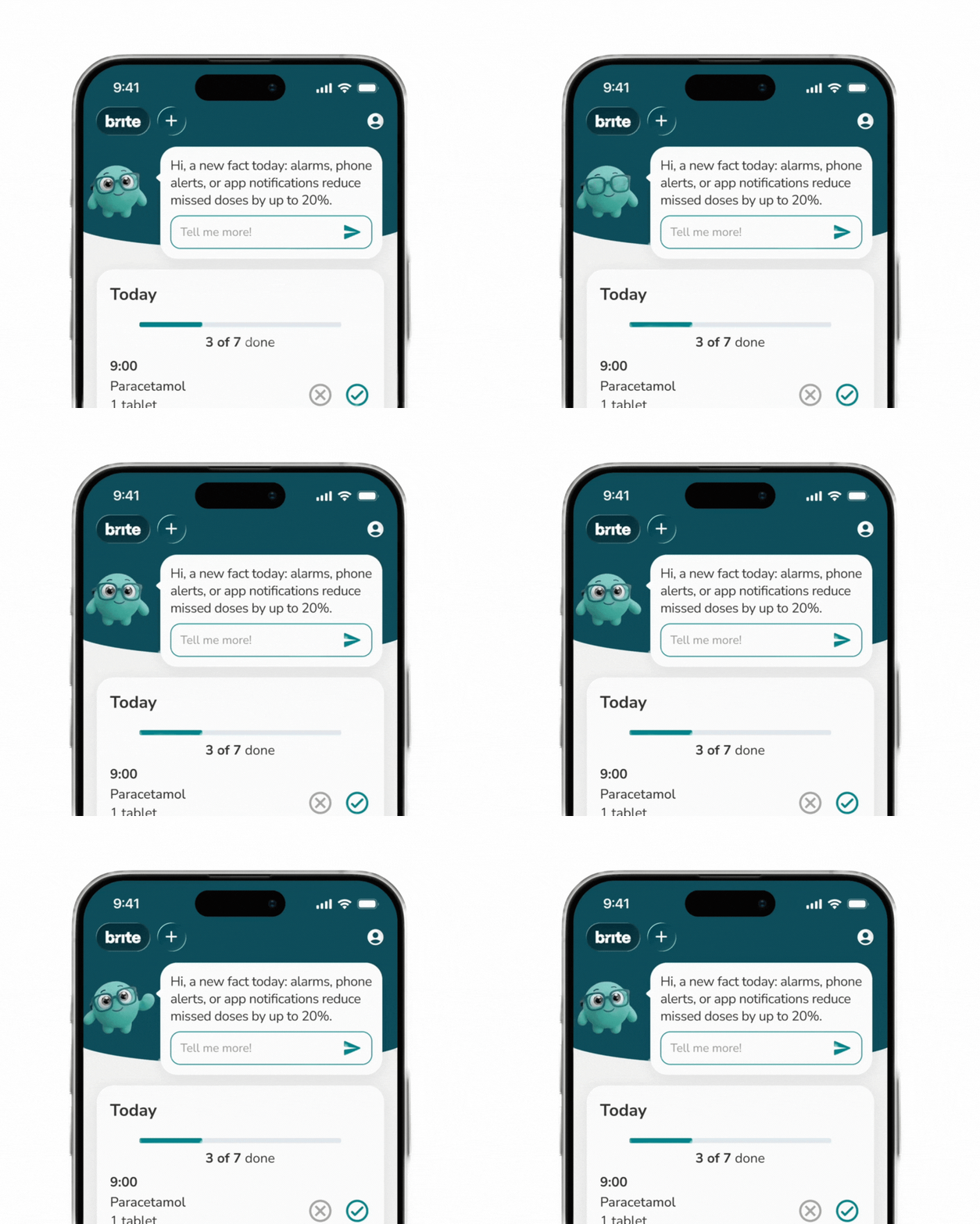
I finally understand my therapy. The app reminds me, answers my questions — and I don't feel alone with it anymore.
Ticagrelor
Ticagrelor: Twice Daily After a Heart Attack — and What Lies Behind the Feeling of Breathlessness
Ticagrelor inhibits the blood platelets and is used together with low-dose aspirin after an acute coronary syndrome, usually for twelve months. Unlike clopidogrel, it acts directly, quickly and reversibly — which is why it has to be taken twice a day, and every missed dose counts. A typical side effect is a feeling of breathlessness that is often harmless but should still be assessed by a doctor.
Platelet aggregation inhibitor, direct and reversible P2Y12 receptor blocker (cyclopentyl-triazolopyrimidine)
Dosage forms
Film-coated tablets of 60 mg and 90 mg (original product and generics)
Half-life
About 7 hours, the active breakdown product about 8.5 hours according to the SmPC — hence two doses a day
Maximum daily dose
After a single loading dose of 180 mg, 2 × 90 mg daily according to the SmPC; in long-term treatment after a heart attack 2 × 60 mg — set by the practice
Onset of effect
Measurable platelet inhibition about 30 minutes after the loading dose, maximum after 2 to 4 hours
Prescription status
Prescription-only medicine
Notable feature
Always together with low-dose aspirin (unless prescribed otherwise); often a temporary feeling of breathlessness; the effect wears off faster after stopping than with clopidogrel, so gaps are riskier
Table scrolls to the right
2. How it works: direct, fast and reversible
After a heart attack or unstable angina — grouped together as acute coronary syndrome — and especially after a stent has been placed in a coronary artery, the greatest risk is a new blood clot. Blood platelets (thrombocytes) play a key role in this. Among other things, they are activated by the messenger substance ADP, which docks onto a receptor called P2Y12. Ticagrelor blocks exactly this receptor.¹
You may know the principle from clopidogrel: clopidogrel also inhibits P2Y12. The difference lies in the details, and almost all everyday questions about ticagrelor follow from it:
Direct rather than a precursor: clopidogrel first has to be converted into its active form in the liver, which works better in some people than in others. Ticagrelor acts by itself — the effect starts faster and is more consistent.
Reversible rather than permanent: clopidogrel blocks a platelet for its entire lifespan. Ticagrelor detaches from the receptor again. When the level falls, platelet function returns — hence twice a day, and hence missed doses matter more.
Stronger: in the large licensing trial PLATO, ticagrelor lowered the risk of cardiovascular death, heart attack and stroke compared with clopidogrel — with more bleeding that was not related to bypass surgery.¹,²
Side effect via adenosine: ticagrelor also increases the amount of the body’s own messenger substance adenosine in the tissues. This probably contributes to the typical feeling of breathlessness (section 6).¹
Ticagrelor does not replace aspirin but adds to it: as a rule, you take both together — this is called dual antiplatelet therapy (DAPT). Aspirin acts at a different point in platelet activation. The comparison in section 9 describes when aspirin alone is enough and when the combination is needed.
What ticagrelor is licensed for. Together with aspirin, to prevent blocked blood vessels in adults with acute coronary syndrome and after a heart attack at least one year ago with a high risk of further events.¹ In stable coronary heart disease without a recent heart attack, in atrial fibrillation or after thromboses, it is not the medicine of choice — other active ingredients are used there. Which treatment is right is decided by the treating practice.
3. Dosing: loading dose, 90 mg and 60 mg
The following information describes the procedure according to the SmPC. It is not a dosing instruction — the dose and duration are set by the treating practice.¹
Start: a single loading dose of 180 mg (two 90 mg tablets), usually given in hospital or already in the emergency ambulance.
First year after acute coronary syndrome: 90 mg twice a day, together with low-dose aspirin (75 to 150 mg daily according to the SmPC). Twelve months are recommended, unless there are medical reasons for stopping earlier.
Increased bleeding risk after a stent: here the practice may consider leaving out aspirin after three months and continuing ticagrelor alone for a further nine months.
More than a year after a heart attack: with a high risk of further events, ticagrelor can be continued at the lower strength of 60 mg twice a day. According to the SmPC, only limited data are available on treatment beyond three years.
Switching from another antiplatelet medicine: according to the SmPC, the first dose of ticagrelor is taken 24 hours after the last dose of the previous medicine.
Older age and kidneys: no dose adjustment is needed. Ticagrelor must not be used in severe liver impairment.
The European guideline on acute coronary syndrome sets twelve months of dual antiplatelet therapy as the standard and describes when it can be shortened or switched to a weaker medicine — for example with a high bleeding risk.³ After that, treatment usually continues long term with a single antiplatelet medicine, often aspirin.⁴ Exactly how long and with what is stated in your discharge letter or decided during cardiology follow-up.
The end date belongs in the plan. Note the date given in your discharge letter in your medication plan and ask the practice in good time before it is reached — never simply stop when the pack is empty.
4. Taking it: why twice a day really means twice
Because ticagrelor acts reversibly and half of it has been broken down after around seven hours, protection depends directly on taking it regularly. The SmPC explicitly stresses that interruptions should be avoided.¹
Two fixed times, about twelve hours apart. For example 8 am and 8 pm. Link your doses to fixed habits such as breakfast and dinner — ticagrelor can be taken with or without food.
Do not forget the aspirin. Aspirin is usually added once a day, mostly in the morning. Two different rhythms are a typical source of mistakes; a weekly pill organiser with morning and evening compartments helps.
Missed a dose? According to the SmPC, do not make it up and do not double the dose, but take the next tablet at the usual time. General rules can be found under missed a medication.
Difficulty swallowing: according to the SmPC, the tablets may be crushed into a fine powder, stirred into half a glass of water and drunk straight away; then rinse with another half glass. More tips under swallowing tablets.
Prescriptions in good time. Plan repeat prescriptions so that there is never a gap — especially before public holidays and trips.
One missed tablet is not a disaster — several are. Especially in the first few months after a stent, protection against stent thrombosis (a clot in the stent) is crucial. If you notice that you regularly miss the evening dose, raise it openly with the practice. A pill reminder on your phone is often the simplest solution.
8 am and 8 pm — every day, for twelve months
The pill reminder alerts you at both times and shows you whether you have already taken today’s dose.
5. Side effects: bleeding, breathlessness, uric acid
According to the SmPC, bleeding and breathlessness are the most frequently reported side effects.¹ Both follow directly from the way it works.
Very common or common
Minor bleeding:bruising even after a light knock, nosebleeds, bleeding gums, cuts that bleed for longer. Annoying, but usually harmless — and a sign that the medicine is working.
Feeling of breathlessness (dyspnoea): very common, usually mild to moderate and often temporary (section 6).
Raised uric acid: very often measurable in the blood; gout attacks are much rarer, but they do occur.
Others: dizziness, headache, fainting, low blood pressure, stomach and bowel complaints such as diarrhoea, nausea or constipation, skin rash and itching, a rise in the creatinine level in the blood.
Less common, but serious
Severe bleeding: in the stomach and bowel, in the urinary tract or — uncommonly — in the head.
Slow heartbeat and conduction disorders: usually without symptoms, but AV block has also been reported since the medicine came onto the market.
Allergic reactions up to and including angioedema (swelling of the face, lips, tongue).
Thrombotic thrombocytopenic purpura (TTP): very rare but life-threatening — a disorder with a lack of platelets, anaemia, fever, confusion or kidney problems.
For monitoring, the SmPC recommends checking kidney values about one month after starting in people with acute coronary syndrome — especially from the age of 75, with impaired kidney function and when an angiotensin receptor blocker such as candesartan or valsartan is taken at the same time.¹
When to call 112 immediately. Black, tarry stools or vomiting blood or material that looks like coffee grounds, larger amounts of blood in the urine, bleeding that cannot be stopped, a sudden severe headache, paralysis, speech or vision problems, and severe breathlessness with chest pain are emergencies: call 112 (emergency number in Germany) immediately. More on how to assess this under black stool and blood in urine. Even then, do not stop ticagrelor on your own, but tell the emergency team that you take it.
6. The feeling of breathlessness: harmless or a warning sign?
This is the question that worries people on ticagrelor most often — understandably, because after a heart attack, “breathlessness” sounds like heart failure. The SmPC gives unusually precise information on this.¹
What is known
Common: in the PLATO trial, 13.8 per cent of people on ticagrelor reported breathlessness, compared with 7.8 per cent on clopidogrel. In the long-term trial with 60 mg (PEGASUS), the figures were 14.2 per cent compared with 5.5 per cent on aspirin alone.¹
Usually mild: most episodes were mild to moderate and often occurred once, shortly after starting treatment; about 30 per cent resolved within a week. Only 0.9 per cent stopped the trial medication because of it.¹
No lung damage: according to the SmPC, breathlessness on ticagrelor was not associated with new or worsening heart or lung disease, and lung function tests remain unchanged.¹
Suspected cause: the mechanism has not been fully explained. One explanation under discussion is the raised adenosine level, which stimulates nerve fibres in the lungs and creates the feeling of not being able to breathe properly — without too little oxygen actually getting through.
Who is more likely to be affected: older people and people with heart failure, asthma or COPD. According to the SmPC, ticagrelor should be used with caution in asthma or COPD.
Typical is an “air hunger” — the urge to take a deep breath, often at rest and unrelated to exertion. Unpleasant, but not an emergency in itself.
Harmless or needs checking?
Observation
Assessment
What to do
Feeling of not being able to breathe deeply, at rest, a few days to weeks after starting; ability to cope with exertion unchanged
Typical of ticagrelor, usually harmless
Keep taking it, note your observations and raise them at your next appointment
The feeling lasts for weeks and clearly disrupts sleep or everyday life
Distressing side effect
Report it to the practice soon — switching to a different antiplatelet medicine is possible, but only under medical supervision
Breathlessness on exertion that is new or getting worse, swollen legs, rapid weight gain, breathlessness when lying down
May point to heart failure — do not automatically blame ticagrelor
Have it checked by a doctor the same day
Pauses in breathing during sleep noticed by family members, severe daytime sleepiness
Central sleep apnoea has been reported since the medicine came onto the market
Raise it; consider further investigation
Sudden severe breathlessness, chest pain, wheezing, swelling of the face
Emergency
Call 112 immediately
Table scrolls to the right
The second part of the SmPC statement is important: new or worsening breathlessness should be fully investigated.¹ After a heart attack, shortness of breath can also come from weakened pumping function, anaemia caused by unnoticed bleeding, beta blockers or a lung disease. More on the causes under acute breathlessness.
Do not stop — report it. If you simply leave out ticagrelor because of the feeling of breathlessness, you exchange an unpleasant, usually harmless side effect for a real risk: a clot in the stent or another heart attack. If ticagrelor is not tolerated, the practice can switch you to a different antiplatelet medicine — seamlessly and without a gap in protection.
7. Do not stop on your own: stent, surgery, dentist
According to the SmPC, stopping antiplatelet therapy early can increase the risk of cardiovascular death, heart attack and stroke.¹ Because ticagrelor acts reversibly, the protection has largely disappeared after a few days. That makes it easy to plan around — but also sensitive to spontaneous breaks.
Planned operations
If there should be no platelet inhibition during a planned operation, ticagrelor is stopped five days beforehand according to the SmPC.¹ Whether this is necessary is decided jointly by the surgeon and the cardiology practice — not in the waiting room. In the first year after a stent, procedures that can wait are often postponed. How to prepare for this discussion is explained in the guide medications before surgery.
Dentist, colonoscopy, minor procedures
Dental cleaning, fillings and often simple tooth extractions are usually possible without stopping; the practice then uses local measures to stop bleeding. For colonoscopies with polyp removal or other procedures with a higher risk of bleeding, the approach is planned individually. At every appointment, actively say that you take ticagrelor and aspirin — the SmPC explicitly asks you to inform your doctor and dentist before any operation.¹
If bleeding occurs
An important point for emergency teams: according to the SmPC, platelet transfusions hardly reverse the effect of ticagrelor as long as the active ingredient is still in the blood.¹ That is why ticagrelor belongs in your emergency and medication plan, clearly visible. Everyday tips for living with a tendency to bleed can be found in the guide living with blood thinners.
8. Interactions
Ticagrelor is broken down mainly by the liver enzyme CYP3A4 and pumped out of cells by the transport protein P-glycoprotein. It weakly inhibits CYP3A4 itself and raises the levels of some other medicines. On top of this come all medicines that increase the tendency to bleed.¹
Slower pulse possible; diltiazem and verapamil can also raise ticagrelor levels
With caution; report dizziness or fainting
Morphine and other opioids (especially in the acute phase)
Absorption of ticagrelor delayed and reduced
Mainly relevant in hospital; inform the practice
Grapefruit juice in large amounts
About double the ticagrelor level
Usually not clinically relevant according to the SmPC; still avoid large amounts
Table scrolls to the right
The most commonly underestimated medicines in everyday life are over-the-counter painkillers. A pack of ibuprofen for back pain or an effervescent aspirin tablet for a headache noticeably increase the risk of stomach bleeding on ticagrelor plus aspirin. Paracetamol or metamizole are often the better choice, but these should also be briefly discussed; background in painkillers compared. Many people on dual antiplatelet therapy are also given a stomach protector such as pantoprazole — unlike with clopidogrel, no interaction with stomach protectors is known for ticagrelor.
The SmPC does not list a specific interaction with alcohol. However, larger amounts irritate the stomach lining and thus increase the risk of bleeding; after a heart attack, restraint makes sense anyway. More on this under medications and alcohol. With every new prescription — including antibiotics, antifungals or HIV medicines — it is worth taking a look at the interaction check.
9. Ticagrelor, clopidogrel, prasugrel and aspirin compared
Ticagrelor is not “better” or “worse” than the other antiplatelet medicines, but intended for a particular situation: the year after an acute coronary syndrome. Detailed profiles of the two neighbouring active ingredients can be found under clopidogrel and aspirin.
Active ingredient
Mode of action
Dosing
Typical role and notable feature
Aspirin (low-dose)
Inhibits the enzyme COX-1 in the platelets, permanently
Once a day
Basis of almost every antiplatelet therapy in coronary heart disease, usually for life
Clopidogrel
Precursor, activated in the liver; blocks P2Y12 permanently
Once a day
In stable coronary heart disease, after a stent with a high bleeding risk, in combination with anticoagulants; effect varies between individuals; no breathlessness effect
Ticagrelor
Acts directly, blocks P2Y12 reversibly
Twice a day
After acute coronary syndrome; stronger and faster than clopidogrel, but more bleeding and often a feeling of breathlessness
Prasugrel
Precursor, activated more reliably than clopidogrel; blocks P2Y12 permanently
Once a day
After acute coronary syndrome treated with a catheter procedure; not after stroke or TIA; used cautiously in older people and those with low body weight
Table scrolls to the right
To put it honestly: the 2023 European guideline names prasugrel as the preferred option over ticagrelor in acute coronary syndrome treated with a stent, unless there are reasons against it; ticagrelor remains an equally established alternative, for example if it was already started before the cardiac catheter examination.³ Which antiplatelet medicine suits you depends on your bleeding risk, age, weight, previous strokes, other medicines and tolerability. A switch — for example because of persistent breathlessness or bleeding — is possible and is planned by the practice without a gap in protection.
10. Special situations: pregnancy, older age, kidneys, liver, gout
Pregnancy and breastfeeding: there are hardly any data on ticagrelor in pregnancy; the SmPC does not recommend its use and advises women of childbearing age to use reliable contraception. During breastfeeding, a decision is made on whether to stop breastfeeding or stop the treatment.¹ General information under medications during pregnancy.
Older age: no dose adjustment, but a higher risk of bleeding and more frequent feelings of breathlessness. Falls with a head injury are particularly serious on dual antiplatelet therapy — after a fall onto your head, it is better to have it checked by a doctor once too often.
Kidneys: no dose adjustment; checking kidney values about one month after starting is recommended in acute coronary syndrome. In chronic kidney disease, the risk of bleeding is generally higher.¹
Liver: contraindicated in severe liver impairment, only with caution in moderate impairment.
Gout: ticagrelor can raise uric acid. According to the SmPC, caution is needed with a history of gout or raised uric acid; ticagrelor is not recommended in kidney disease caused by uric acid.¹
Previous stroke or brain haemorrhage: ticagrelor is contraindicated after a brain haemorrhage. After an ischaemic stroke, treatment for up to twelve months is possible; long-term treatment beyond that is not recommended owing to a lack of data.¹
11. Ticagrelor experiences: what patients really ask
“Since the stent, I feel as if I can’t breathe properly. Am I imagining it?”
No, this is one of the best-known side effects of ticagrelor and occurs in about one in seven people. Typical is air hunger at rest, often in the first few days to weeks, without your ability to cope with exertion getting worse. In many people it eases off. It should still be assessed by a doctor, because after a heart attack the heart itself can also be the cause. Note down when it occurs and whether you manage stairs less well than before. If it does not improve and bothers you in everyday life, switching to a different antiplatelet medicine is a real option.
“I forgot my evening dose. Should I take two in the morning?”
No. According to the SmPC, you simply take the next tablet at the usual time, without making up the missed one or doubling the dose. A single missed dose is usually no reason to panic. But if it happens more often, the protection drops again and again — and with a recent stent, that is a real risk. A fixed evening reminder or linking the dose to brushing your teeth helps many people.
“I keep getting bruises and bleeding gums. Is the dose too high?”
Probably not — it is the expected price of platelet inhibition, especially as you take two active ingredients at once. Minor bleeding is annoying, but usually harmless. Still raise it, especially if nosebleeds are frequent or long-lasting, your periods become noticeably heavier or you feel increasingly drained — then you will be checked for anaemia. Black stools or blood in the urine, on the other hand, are not a mere nuisance but need to be checked immediately.
“The year is up. Do I have to stop now?”
That is decided by the cardiology practice, not by the date alone. Ticagrelor often ends after twelve months and aspirin continues on its own. With a high risk, ticagrelor can be continued at the lower strength of 60 mg twice a day; with a high bleeding risk, the treatment may already have been reduced earlier. Call in good time before the deadline or raise it at your check-up — and do not simply stop because the last pack is empty.
Ibuprofen, clarithromycin, a statin — do they go with ticagrelor?
The interaction check reviews your whole list, including over-the-counter painkillers.
Ticagrelor binds reversibly to the blood platelets, and half of it has been broken down after about seven hours. When the level falls, platelet function returns. Two doses about twelve hours apart keep the protection steady.
A feeling of breathlessness is very common, usually mild and often temporary; according to the SmPC, it is not associated with lung or heart damage. New or increasing breathlessness should still be checked by a doctor, because after a heart attack it can also be caused by heart failure. Sudden severe breathlessness with chest pain is an emergency for 112.
Both inhibit the same receptor on the blood platelets. Ticagrelor acts directly, faster, more strongly and reversibly and is taken twice a day; clopidogrel first has to be activated in the liver, acts permanently and is taken once a day. Ticagrelor causes more bleeding and more frequent breathlessness.
After an acute coronary syndrome, the SmPC generally recommends twelve months of 90 mg twice a day together with aspirin. With a high bleeding risk the treatment can be shortened, and with a high risk of new blocked blood vessels it can be extended at 60 mg. The exact duration is set by the cardiology practice.
If there should be no platelet inhibition during a planned operation, ticagrelor is stopped five days beforehand according to the SmPC. Whether this is necessary is decided jointly by the surgeon and the cardiology practice. Many minor procedures, for example at the dentist, are possible without a break.
Better not without checking first. Anti-inflammatory painkillers such as ibuprofen or diclofenac, together with ticagrelor and aspirin, increase the risk of stomach and bowel bleeding. For occasional pain, paracetamol or metamizole are often the better-tolerated choice.
According to the SmPC, you only take the next tablet at the usual time, without making up the missed one or doubling the dose. You should avoid frequent gaps, because the protection against a clot in the stent then drops repeatedly.
Summary of Product Characteristics (SmPC) for Brilique (ticagrelor) 60 mg and 90 mg film-coated tablets (European Medicines Agency, EPAR product information; current version). ema.europa.eu
Wallentin L et al. (PLATO Investigators): Ticagrelor versus clopidogrel in patients with acute coronary syndromes. New England Journal of Medicine 2009; 361: 1045–1057. nejm.org
ESC Guidelines for the management of acute coronary syndromes (European Society of Cardiology, 2023; German pocket guideline from the DGK, the German Cardiac Society). leitlinien.dgk.org
German National Disease Management Guideline (Nationale VersorgungsLeitlinie) on chronic coronary heart disease (German Medical Association, National Association of Statutory Health Insurance Physicians, AWMF; current version) — German source. leitlinien.de
Get through the year after your stent well — with brite
Reminders for both ticagrelor doses and aspirin, notes on breathlessness and bleeding for your doctor’s appointment and an interaction check. Free.
Medical disclaimer: This article is for general information and does not replace medical advice, diagnosis or treatment. Never stop or pause ticagrelor on your own — not even because of a feeling of breathlessness, bruising or before a procedure — but discuss every change with your cardiology practice. If you have black stools, vomit blood, have bleeding that cannot be stopped, a sudden severe headache, paralysis or acute breathlessness with chest pain, call 112 (emergency number in Germany) immediately. The choice of medicine and the dose are always set individually by the treating practice. Last updated: October 2026.