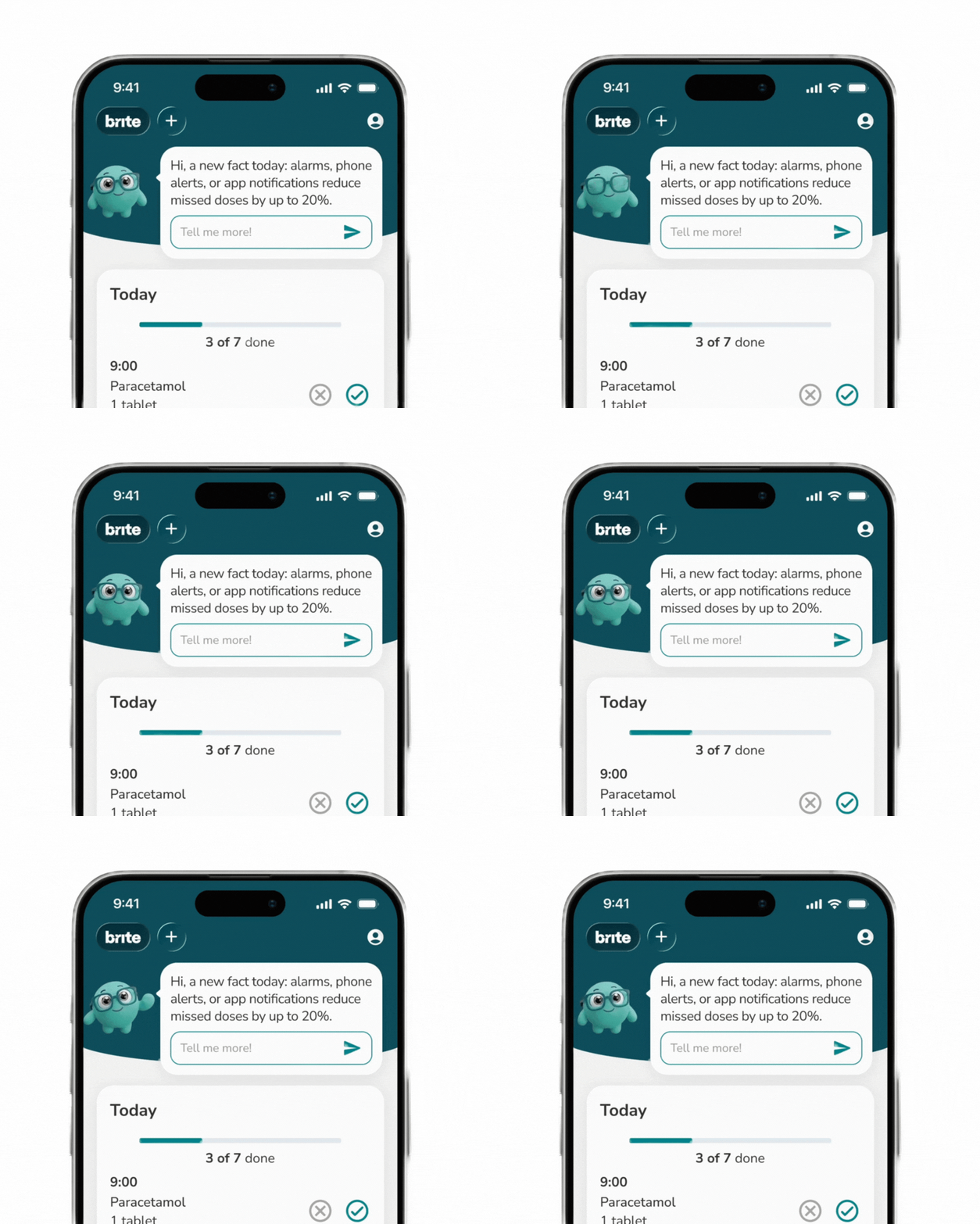
I finally understand my therapy. The app reminds me, answers my questions — and I don't feel alone with it anymore.
Melperone
Melperone: Agitation and Sleep Problems in Older Age — Dosing, Fall Risk and the Heart
Melperone is a low-potency neuroleptic that, in Germany, is prescribed mainly for older people with agitation, night-time confusion and sleep problems. It causes hardly any anticholinergic side effects and is therefore regarded as comparatively suitable for older age. Even so, it increases the risk of falls, can prolong the QT interval on the ECG and is linked to an increased risk of death in dementia — the dose should be as low and the treatment as short as possible.
Low- to medium-potency neuroleptic from the butyrophenone group
Dosage forms
Film-coated tablets (e.g. 25, 50 and 100 mg), oral solution
Half-life
4 to 6 hours after a single dose, about 6 to 8 hours with repeated use according to the SmPC
Maximum daily dose
According to the SmPC, up to 400 mg for severe states of agitation and delusions; in older people a fraction of this is often enough. The dose is set by the practice
Onset of effect
Calming and readiness for sleep after about 1 to 2 hours; antipsychotic effect sometimes only after 2 to 3 weeks
Prescription status
Prescription-only
Notable feature
Hardly any anticholinergic effect, no potential for dependence as with benzodiazepines; but fall risk, QT prolongation, blood count checks and increased mortality in dementia
Table scrolls to the right
2. How it works: calming rather than switching off
Melperone belongs to the neuroleptics (antipsychotics), but works differently from the well-known high-potency members of the group. It blocks the docking sites of the messenger substance dopamine only weakly — according to the SmPC, about 200 times more weakly than haloperidol — and instead clearly dampens the effect of serotonin. At low doses, this first leads to emotional relaxation and greater readiness for sleep; only higher doses affect delusions and hallucinations.¹
This makes melperone a close relative of quetiapine, which is also often given at low doses for sleep problems. The difference: in Germany, melperone is explicitly licensed for sleep disorders and states of confusion, especially in older people; quetiapine is used for this off-label. You will find the comparison of the two active ingredients in section 8 — this article focuses on use in older age.
Strengths: according to the SmPC, the anticholinergic and antihistaminergic effect is barely measurable.¹ Melperone therefore causes dry mouth, constipation, urinary retention and confusion less often than older sleeping pills and sedatives — an important point for the anticholinergic burden. It is not addictive in the way benzodiazepines are and, according to current knowledge, does not lower the seizure threshold.
Weaknesses: melperone also blocks alpha receptors on the blood vessels — resulting in a drop in blood pressure on standing up and dizziness. In the heart, it acts similarly to a class III antiarrhythmic and can prolong the QT interval. And like all neuroleptics, it can trigger movement disorders, although less often than high-potency medicines.
An honest assessment. Melperone is an old medicine with a broad licence that has grown over time. Good modern studies on its benefits and risks in dementia, delirium and sleep problems in older age are largely lacking. The fact that it is prescribed so often is based mainly on experience and on the alternatives having their own drawbacks — not on strong study evidence.²
3. Dosing: as low and as short as possible
The following information reflects the SmPC and is not a dosing instruction. The SmPC itself sets out the principle of keeping the dose as low and the duration of treatment as short as possible.¹ Which dose is right is decided by the treating practice.
Mild calming and relief of anxiety: generally 25 to 75 mg a day.
Agitation and confusion: 50 to 100 mg a day to start with; if needed, this can be increased to up to 200 mg over several days.
Severe agitation with aggression, delusions or hallucinations: up to 400 mg a day.
Older people: dose cautiously because of higher sensitivity; according to the SmPC, a low dose is often enough.
Kidney, liver and circulatory diseases: dose cautiously and check these functions regularly. Melperone is contraindicated in severe liver failure.
Children under 12: must not be treated with melperone according to the SmPC.
A dose for sleep is not a dose for agitation. In everyday care, “a small tablet in the evening to help with sleep” can quickly turn into long-term medication with additional as-needed doses during the day. Every increase should be agreed with the practice and noted in the medication plan, with the date and reason. As-needed doses need a clear maximum amount per day.
The SmPC allows use without a time limit.¹ But especially with agitation in the context of an acute illness or a move into a care home, it is worth checking regularly whether melperone is still needed. How to review long-term medication is described in the guide reviewing long-term medication. After longer use, the dose is usually reduced step by step rather than stopped abruptly — the practice decides how.
4. Taking it day to day: not with coffee, tea or milk
Take it with water. Butyrophenones can form poorly soluble compounds with coffee, tea and milk; absorption may fall and the effect may be weaker. The SmPC therefore advises against taking melperone with these drinks.¹ More on this in the guides medications and coffee and medications and dairy.
After meals and before bed. The daily dose is divided into several single doses, ideally after meals or before going to sleep. For a stronger calming effect at night, a higher dose can be chosen in the evening.¹
For sleep, give it in good time, not in the middle of the night. The effect starts after about one to two hours. A dose at three in the morning often still works at breakfast — with drowsiness and a risk of falling on the first trip to the toilet.
Measure the solution exactly. For swallowing difficulties, there is an oral solution with a measuring cup. Do not crush tablets without checking first; tips in the guide how to swallow tablets.
Missed dose: do not make it up if the next one is due soon anyway, and never give a double dose. If the evening dose was forgotten, a late dose in the night is usually worse than a restless night.
Driving and hazardous activities. According to the SmPC, driving, operating machinery and other hazardous activities should be avoided altogether, at least in the first phase of treatment — even more so in combination with alcohol.¹ The practice decides in each individual case; see medications and driving.
How was the night? Record sleep, agitation and as-needed doses
At the next doctor's appointment, a history shows whether melperone helps — or just makes you tired.
5. Side effects: tiredness, circulation, movement disorders
According to the SmPC, therapeutic doses usually have no or only a slight influence on breathing, digestion, urine output and liver function. The typical side effects concern alertness, circulation and mobility:¹
Tiredness: especially at the start of treatment — welcome in the evening, a fall risk during the day.
Circulation: low blood pressure and a drop in blood pressure on standing up with a faster pulse, especially at the start and at higher doses. More under low blood pressure.
Heart rhythm: prolongation of the QT interval on the ECG, in rare cases dangerous rhythm disorders (torsade de pointes).
Movement disorders: especially at higher doses, cramps of the tongue, throat or eye muscles, Parkinson-like tremor and stiffness, or distressing restlessness (akathisia). Late, often permanent movement disorders (tardive dyskinesia) have only been reported in isolated cases.
Others: raised liver values, jaundice, skin rash, changes in the blood count, weight gain, sexual dysfunction, menstrual disorders; in addition, dry mouth, constipation, headache, nausea and a drop in sodium levels cannot be ruled out.
When you need help immediately. High fever with muscle stiffness and reduced consciousness can be neuroleptic malignant syndrome — a rare, life-threatening reaction: call 112 (emergency number in Germany) immediately. The same applies to fainting, a racing or irregular heartbeat with dizziness, cramps of the throat or tongue with shortness of breath, and sudden paralysis, numbness in the face, speech or visual disturbances (signs of a stroke). Fever, a sore throat or inflammation in the mouth, especially in the first three months, can indicate a dangerous lack of white blood cells: in that case, do not treat it yourself with painkillers, but see the practice immediately.¹
According to the SmPC, the blood count should be checked before treatment starts.¹ Movement disorders and Parkinson-like signs usually resolve after the dose is reduced or the medicine is stopped. Relatives and carers should therefore report observations such as new stiffness, a shuffling gait or constant restlessness early, rather than putting them down to age.
6. Falls, heart, dementia: the three risks in older age
This is the most important section of this article. Melperone is used almost exclusively in people who are already vulnerable: very elderly, often with dementia, heart disease and many medicines. This is exactly where its three main risks show up.
Risk 1: falls at night
With melperone, tiredness, a drop in blood pressure on standing up and slower reactions come together — and mainly at night, when older people go to the toilet. For the very elderly, a fall with a broken hip can mean the end of independent living. The more sedating medicines come together, the higher the risk; see the guide dizziness from medications.
Light and route: a night light, a clear path to the toilet, possibly a commode next to the bed.
Get up slowly: first sit on the edge of the bed, wait for a few breaths, then stand up.
Non-slip shoes instead of socks, and glasses within reach.
Record falls: note the time and how long it was since the last dose of melperone — this helps the practice adjust the dose and timing.
Risk 2: the heart and the QT interval
Melperone can prolong the QT interval on the ECG; in rare cases, dangerous rhythm disorders occur. According to the SmPC, particular caution is needed with pre-existing heart damage, a slow pulse, a low potassium level, congenital long QT syndrome and when taking other medicines at the same time that prolong the QT interval or lower potassium levels. With heart disease, regular ECG checks should be carried out.¹ An ECG before starting and after dose increases is therefore not overcautious in people with heart disease.
Risk 3: dementia, stroke and mortality
In large studies, older people with dementia who were taking classic neuroleptics had a slightly increased risk of death; with some newer antipsychotics, the risk of stroke was increased about threefold. The SmPC applies this warning to melperone: whether it is used for behavioural disturbances in the context of dementia must be assessed in each individual case, and caution is needed with an increased risk of stroke.¹ On top of this comes an increased risk of blood clots (thromboses and pulmonary embolisms), which matters particularly in people who are bedridden.
First the cause, then the sedative. Sudden agitation or confusion in older age often has a treatable trigger: pain, a urinary tract infection, lack of fluids, constipation, a new medicine, urinary retention or unfamiliar surroundings. The dementia guideline therefore puts the search for triggers and non-drug measures first — a daily structure, light, exercise, familiar people.² Melperone can bridge a crisis, but it does not replace these steps.
In concrete terms, this means for relatives: with every new prescription, ask what melperone is supposed to achieve — sleep, less night-time agitation, less aggression? — how you will recognise that it is working, and when it will be reviewed. Many care homes and practices work with regular medication reviews; the guide medications in care homes explains how you can get involved.
7. Interactions
Melperone is broken down almost entirely in the liver and acts on the brain, circulation and heart. The most important interactions therefore concern the total sedation, blood pressure and the QT interval.¹
Combination
Consequence
What to do
Alcohol
Stronger effect of alcohol, risk of falls and accidents
Avoid; melperone is contraindicated in alcohol poisoning
Sleeping pills such as zopiclone, sedatives such as lorazepam, opioids, other psychiatric medicines, sedating antihistamines
Increased tiredness, up to suppressed breathing
Have the overall burden checked, use low doses
Tricyclic antidepressants
Each strengthens the other's effect
Coordinate with a doctor
Blood pressure medicines
Greater drop in blood pressure, dizziness on standing up
Check blood pressure sitting and standing
Medicines that prolong the QT interval: antiarrhythmics, macrolide antibiotics such as clarithromycin, certain antihistamines
Dangerous heart rhythm disorders
Avoid according to the SmPC
Water tablets that lower potassium, such as furosemide
According to the SmPC, keep the doses of both as low as possible
Monitor levels and side effects closely
Table scrolls to the right
Two combinations are typical in everyday life. The first is the sedation chain: melperone at night, plus a sleeping pill, an opioid for pain and a sedating antidepressant — each justifiable on its own, but together a considerable risk of falls and breathing problems. The second is the QT chain in people with dementia and heart disease: anti-dementia medicines such as donepezil, some antidepressants and antibiotics can also affect the QT interval. A check for interactions across the complete list — in the brite app via the interaction check — makes such chains visible.
Another point is not in every SmPC but is described in pharmacological interaction databases: melperone itself inhibits the liver enzyme CYP2D6, which breaks down, for example, metoprolol and some antidepressants. Their levels can rise as a result. If pulse or blood pressure drop markedly with this combination, the practice should know about it.
8. Melperone, quetiapine or nothing at all? The comparison
There is no ideal medicine for agitation and sleep problems in older age. Every option comes at a price — which is why non-drug treatment comes first, and a medicine is used in a targeted way, at a low dose and for a limited time.
Option
Licensed for sleep/agitation in older age
Strength
Typical drawback
Melperone
Yes, for sleep disorders, confusion and agitation, especially in geriatrics
Hardly anticholinergic, no dependence, flexible dosing
Fall risk, QT prolongation, few modern studies
Quetiapine (low dose)
No, off-label for sleep
Strongly sedating, often preferred for psychosis in Parkinson's
Weight gain and metabolic effects, drop in blood pressure, QT
Short-term for persistent aggression in Alzheimer's dementia
The best-studied antipsychotic for aggression in dementia
Movement disorders, stroke risk
Benzodiazepines and Z-drugs
Short-term for sleep and anxiety
Rapid effect
Dependence, falls, confusion — particularly problematic in older age
Non-drug measures
—
No side effects, often treat the cause
Need time, staff and patience
Table scrolls to the right
For sleep disorders without agitation or confusion, the S3 guideline on insomnia does not recommend neuroleptics because of insufficient data and their side effects; first place there goes to cognitive behavioural therapy for insomnia.³ If you “only” sleep badly, you should therefore ask whether melperone is really necessary. The guides sleeping pills: what helps and alternatives to sedatives give an overview of alternatives.
9. Special situations: Parkinson's, heart, liver, pregnancy
Parkinson's and Lewy body dementia: according to the SmPC, only with particular caution; melperone can weaken the effect of Parkinson's medicines.¹ Many people with Parkinson's or Lewy body dementia react very sensitively to neuroleptics — the choice belongs in expert hands.
Heart disease: caution with pre-existing heart damage, a slow pulse, rhythm disorders and low potassium; regular ECG checks.
Low blood pressure: severe hypotension or disorders of circulatory regulation call for particular caution.
Liver: contraindicated in severe liver failure; with milder disorders, dose cautiously and check values.
Blood count: check before starting; with abnormal values, only if absolutely necessary and with frequent checks.¹
Epilepsy: according to the available data, melperone does not lower the seizure threshold; existing anti-epileptic treatment must, however, continue.
Alcohol use disorder: melperone is licensed for agitation in alcohol use disorder, but must not be given in acute alcohol poisoning. See alcohol dependence.
Pregnancy: according to the SmPC, there are no data, and melperone should not be prescribed during pregnancy. After use in the last trimester, movement disorders and withdrawal symptoms can occur in the newborn.¹ If you are planning a pregnancy or are pregnant, a better-studied alternative should be discussed; Embryotox offers individual advice.⁴
Breastfeeding: because it is unknown how much passes into breast milk, breastfeeding must be stopped according to the SmPC if melperone is absolutely necessary.
10. Melperone experiences: what relatives and patients really ask
“Since starting melperone, my father is just tired all day.”
This is a common signal that should be taken seriously. In older people, daytime tiredness means less exercise, less drinking, poorer eating and a higher risk of falls — and often a more restless next night, because the day-night rhythm tips over. Possible reasons are a dose that is too high, an evening dose given too late or the combination with other sedating medicines. For a few days, note when the tablets are given and how alert he is, and raise it with the practice. Please do not leave them out or halve them on your own.
“My mother was given melperone in hospital. Does she have to take it for ever now?”
Not necessarily. In hospital, melperone is often given for acute confusion (delirium) triggered by an infection, surgery or unfamiliar surroundings. Once the cause subsides, the medicine is often no longer needed — but it remains on the discharge letter. Ask the GP practice specifically whether and when an attempt to stop it makes sense. The guide after hospital discharge explains what to look out for at the handover.
“Isn't melperone better than a sleeping pill?”
In one respect, yes: it is not addictive in the way benzodiazepines or Z-drugs are, and it has hardly any anticholinergic effect. But it is not a harmless sleeping pill. The fall risk, the heart rhythm and the warning in dementia apply even at low doses. For pure problems falling or staying asleep, the guideline recommends behavioural measures first. Melperone is more of an option when night-time agitation or confusion is in the foreground.
“Can my mother drink her evening tea with the tablet?”
Better not at the same time. The SmPC advises against taking melperone with coffee, tea or milk, because poorly soluble compounds can form. A glass of water with the tablet and the tea a little later is a simple solution. Above all, what matters is that the dose is taken the same way every evening — so that the effect stays predictable.
Sleeping pills, painkillers, heart tablets — how much is adding up?
The interaction check tests melperone against the entire medication list — including as-needed medicines.
Melperone is licensed for sleep disorders, states of confusion and to calm agitation and excitement, particularly in older people and in psychiatry. In Germany, it is used mainly for night-time agitation and confusion in older age. The dose should be as low and the treatment as short as possible.
Dependence like that seen with benzodiazepines is not known with melperone. Even so, after longer use it is usually reduced step by step rather than stopped abruptly, so that sleep problems and agitation do not suddenly return. The practice decides how.
The calming and sleep-promoting effect starts about one to two hours after taking it. According to the SmPC, an effect against delusions or hallucinations may only set in after two to three weeks. For sleep, melperone is therefore given in good time in the evening, not in the middle of the night.
In older people with dementia, mortality is slightly increased with neuroleptics, and the risk of stroke can rise. According to the SmPC, whether melperone is used for behavioural disturbances in the context of dementia must therefore be assessed in each individual case. Triggers such as pain or infections should be looked for first, and non-drug measures exhausted.
Melperone can form poorly soluble compounds with coffee, tea and milk. As a result, less active ingredient may be absorbed and the effect may be weaker. The SmPC therefore recommends taking it with water or another drink.
Both are neuroleptics that calm and cause sleepiness at low doses. In Germany, melperone is licensed for sleep disorders and confusion in older age, while quetiapine is used for this off-label. Quetiapine more often leads to weight gain and metabolic changes; melperone has hardly any anticholinergic effects. Both can cause a drop in blood pressure and QT prolongation.
According to the SmPC, the blood count should be checked before starting. With heart disease, regular ECG checks are planned, and with liver, kidney and circulatory diseases, checks of these functions. In everyday life, blood pressure when standing, daytime tiredness, falls and movement disorders also matter.
Summary of Product Characteristics (SmPC) for Melperon-ratiopharm 25/50/100 mg film-coated tablets and 25 mg/5 ml oral solution (melperone hydrochloride), as of October 2020; likewise other melperone products — German source. fachinfo.de
S3 guideline on dementia (DGN and DGPPN, AWMF reg. no. 038-013, 2023) — German source. awmf.org
S3 guideline on insomnia in adults (DGSM, AWMF reg. no. 063-003, 2025 update) — German source. awmf.org
Embryotox — German pharmacovigilance and advisory centre for embryonic toxicology (Charité Berlin): neuroleptics in pregnancy and breastfeeding. Accessed 2026. embryotox.de
Keep track of your parents' medicines — with brite
Dose reminders, a history of sleep and falls, interaction check and digital medication plan in one place. Free.
Medical disclaimer: This article is for general information and does not replace medical advice, diagnosis or treatment. Do not change the melperone dose on your own, do not give additional as-needed doses without agreeing this with a doctor, and with dementia, heart disease or Parkinson's, have it checked regularly whether the treatment is still needed. With high fever and muscle stiffness, fainting, a racing heart, signs of a stroke or cramps of the tongue and throat, call 112 (emergency number in Germany) immediately. The choice of medicine and the dose are always set individually by the treating practice. Last updated: November 2026.