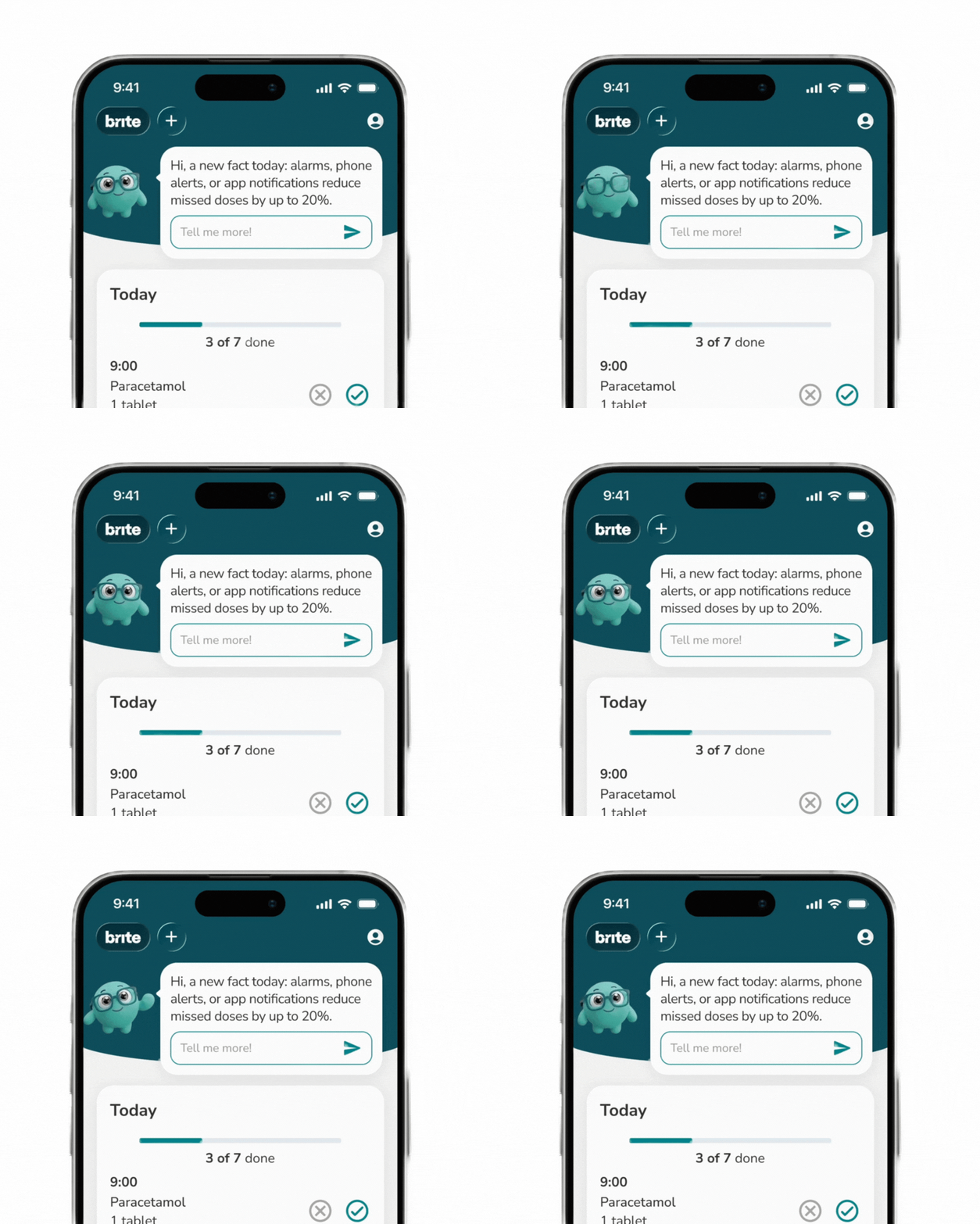
I finally understand my therapy. The app reminds me, answers my questions — and I don't feel alone with it anymore.
Latanoprost
Latanoprost: Evening Drops — Technique, Eyelashes and Iris Colour in Glaucoma
Latanoprost is a prostaglandin analogue and one of the most frequently prescribed eye drops for glaucoma and raised eye pressure. It is used once a day in the evening, and precisely because you cannot feel high eye pressure, your daily routine decides whether the treatment succeeds. Typical effects are a red eye, longer eyelashes and, with some eye colours, a permanently browner iris.
Latanoprost (isopropyl ester, converted in the eye into the active latanoprost acid)
ATC code
S01EE01
Drug class
Prostaglandin F2α analogue (glaucoma medicine)
Dosage forms
Eye drops 50 µg/ml, usually with the preservative benzalkonium chloride; preservative-free products as single-dose units or in special multi-dose containers; fixed combinations, e.g. with timolol
Half-life
Very short in the blood (about 17 minutes); the pressure-lowering effect in the eye lasts at least 24 hours
Maximum daily dose
1 drop in each affected eye once a day — according to the SmPC, using it more often weakens the effect
Onset of action
Pressure starts to fall after about 3 to 4 hours, with the maximum effect after 8 to 12 hours
Prescription status
Prescription only
Special feature
Best effect when used in the evening; permanent browning of the iris possible in mixed-colour eyes, eyelash growth common
Table scrolls to the right
2. How it works: more outflow, less pressure
Latanoprost is approved to lower raised intraocular pressure in open-angle glaucoma and in ocular hypertension (raised eye pressure without damage to the optic nerve), and in children also in paediatric glaucoma.¹ The eye constantly produces aqueous humour, a fluid that nourishes the front parts of the eye and then has to drain away again. If it builds up, the pressure inside the eye rises. Persistently high pressure is the most important modifiable risk factor for the gradual loss of optic nerve fibres in glaucoma. Damage to the visual field cannot be reversed — so the aim of treatment is to stop it progressing.²,³
Latanoprost mimics a tissue hormone the body makes itself, prostaglandin F2α. It binds to its FP receptors in the eye and mainly widens a secondary drainage route, known as uveoscleral outflow, through the tissue of the ciliary muscle. It has little effect on the production of aqueous humour.¹ What you put in your eye is an inactive precursor (an ester), which is converted into the active latanoprost acid as it passes through the cornea. Whatever reaches the rest of the body is broken down by the liver within minutes — which is why side effects throughout the body play a much smaller role than with beta-blocker eye drops.¹
The typical accompanying effects follow from the same mechanism:
Widening of blood vessels: Prostaglandins dilate small blood vessels. The conjunctiva can therefore turn red, especially in the first few weeks.
Hair growth stimulus: Prostaglandin receptors are also found in hair follicles. Eyelashes often become longer, thicker and darker.
More pigment: The pigment cells of the iris and the eyelid skin produce more melanin. This can change your eye colour permanently — more on this in section 6.
Prostaglandin analogues such as latanoprost are among the most effective pressure-lowering eye drops and are listed in the European Glaucoma Society guideline as one of the first-choice options.² That lowering the pressure really does protect your sight was shown by the British UKGTS trial: with latanoprost, the visual field of people with newly diagnosed open-angle glaucoma deteriorated less often and later than with placebo drops (during the study period in 15.2 versus 25.6 per cent of patients).¹,⁴
You do not feel the effect — and that is exactly the problem. In open-angle glaucoma, raised eye pressure usually does not hurt and causes no visual problems for a long time. Only a measurement at the ophthalmology practice shows whether the drops are working. If you skip drops, you notice nothing at first — but your optic nerve does.
3. Dosing: one drop — more is less
The following information reflects what the Summary of Product Characteristics (SmPC) describes. It is not a recommendation for use: whether you use drops, in which eye and which product is decided by your ophthalmology practice.¹
Adults, including older people: 1 drop once a day into the conjunctival sac of the affected eye. According to the SmPC, the best effect is achieved when the drop is used in the evening.
No more than once a day: The SmPC explicitly stresses that using it more often reduces the pressure-lowering effect. A second drop “just to be safe” therefore does not add anything — if anything, it achieves less.
Missed dose: According to the SmPC, treatment simply continues with the next regular dose — no catching up in the morning, no double drop.
Children: Latanoprost is also approved for children with raised eye pressure and paediatric glaucoma and is dosed in the same way as in adults. Data for infants under one year are limited, and there are none for babies born before 36 weeks of pregnancy.
A 2.5 ml bottle contains about 80 drops.¹ Once opened, it keeps for four weeks — even if there is still solution left. This is not a manufacturer’s trick but a question of sterility: every time the bottle is opened, the risk of germs getting in increases.
4. Evening drops: the technique step by step
How to use eye drops correctly in general is explained in the guide Using eye drops correctly. With latanoprost there are a few extra points that come directly from the SmPC or follow from the typical side effects:
Choose a fixed time in the evening. It is best to link the drops to a fixed routine, such as brushing your teeth before bed. Doing it every day matters more than the exact minute.
Take contact lenses out first. The preservative benzalkonium chloride can build up in soft lenses. According to the SmPC, lenses are removed before the drops and put back in no sooner than 15 minutes later.¹
Wash your hands, tilt your head back slightly, pull down the lower eyelid. Put one drop into the pocket this creates. The dropper tip must not touch your eye, eyelashes or fingers.
Close your eyes and press on the inner corner of the eye. The SmPC recommends gently pressing on the tear sac at the inner corner of the eye for one minute straight after the drop. This means less active ingredient drains through the tear duct into your nose and throat — it stays in the eye longer and less of it reaches the rest of the body.¹
Dab any excess off the eyelid skin. Use a clean tissue for drops that run over the edge of the eyelid. This is often recommended because on the skin latanoprost can encourage eyelash and hair growth and darkening of the eyelid skin.
Leave a gap before other eye drops. According to the SmPC, several eye medicines are used at least five minutes apart, otherwise the second drop washes out the first.¹ Gels and eye ointments usually go last.
The SmPC names the evening as the time with the best effect.¹ A practical side benefit: slightly blurred vision straight after the drop and some of the redness happen while you are asleep anyway. If your evenings are very irregular, for example with shift work, talk to the practice about a different fixed time instead of using the drops “at some point”.
Storage: check the pack first. Storage instructions differ from product to product. For the original product, the current SmPC states: do not store above 25 °C, keep the bottle in the outer carton to protect it from light, and use it up within four weeks of opening.¹ Some generic products, on the other hand, should be kept in the fridge until opened. Write the opening date on the label; tips on storage can be found in Storing medications correctly and, for holidays, in Medications and heat.
Two glaucoma drops? Order and a five-minute gap
One reminder per drop, at the right interval — and an alert when the bottle has to go after four weeks.
5. Side effects: red eye, stinging and rare warning signs
Almost all side effects affect the eye itself. Many appear straight after the drop and then fade; in many people the redness becomes weaker after the first few weeks. The overview follows the frequencies given in the SmPC.¹
Side effect
Frequency according to the SmPC
What helps
Mild to moderate redness of the conjunctiva
Very common
Use in the evening; usually improves. If redness is severe or painful in one eye, contact the practice
Macular oedema (swelling of the centre of the retina), uveitis (inflammation of the middle layer of the eye)
Uncommon
Have declining sharpness of vision, distorted vision or a painful red eye checked promptly
Chest pain, palpitations, angina pectoris, shortness of breath, asthma
Uncommon (reported after marketing authorisation)
Get it checked by a doctor straight away; for severe chest pain call 112 (emergency number in Germany)
Herpes inflammation of the cornea, iritis, darkening of the eyelid skin, worsening of existing asthma
Rare
Get a painful red eye with worsening vision seen the same day
Deepening of the upper eyelid crease (periorbital changes), unstable angina pectoris
Very rare
Mention it at the practice
Table scrolls to the right
The “prostaglandin eye” — red and slightly stinging — is the most common reason why people stop using the drops on their own. Before you do: redness and irritation are usually harmless and ease over time in many people. The preservative often plays an additional role. According to the SmPC, benzalkonium chloride can cause irritation and symptoms of dry eyes and can affect the surface of the cornea.¹ If you already have dry eyes or need several preserved drops, you can ask for a preservative-free product; more on additives in the guide Excipients and intolerances.
Not every red eye comes from the drops. An overview of when redness is harmless and when it is not can be found in the article on red eyes.
When you should not wait for your next check-up. A suddenly very painful, red eye with worsening vision, nausea or headache can point to an acute glaucoma attack or inflammation inside the eye — in that case go to an eye hospital or the out-of-hours ophthalmology service the same day. Declining sharpness of vision or distorted lines suggest macular oedema and should be checked promptly. If you have chest pain, shortness of breath or an asthma attack after using the drops, call 112 (emergency number in Germany).
6. Eyelashes, iris colour, eyelid skin: the visible effects
This is the section that often gets too little attention in consultations — and that matters more to many people than the test results. Latanoprost can change the appearance of the eye area. Some of these changes are reversible, one is not.
Iris colour: slow, usually subtle, but permanent
Latanoprost can increase the brown pigment in the iris. The SmPC summarises the data as follows:¹
Who is affected: mainly people with mixed-colour irises — blue-brown, grey-brown, green-brown or yellow-brown. In mixed-colour eyes, the frequency in studies ranged from 7 to 85 per cent, highest with yellow-brown irises. No change was seen in uniformly blue eyes, and only rarely in uniformly grey, green or brown eyes.
When it happens: usually within the first eight months of treatment, rarely in the second or third year, and no longer after the fourth year. In a five-year study, around a third of patients developed increased iris pigmentation.
What it looks like: the brown usually spreads in a ring from the pupil outwards. The change is often so slight that nobody notices it in everyday life.
What remains: the colouring is permanent. After stopping it does not increase any further, but it does not fade either. Moles and freckles on the iris do not change.
Only one eye being treated? Then raise the colour issue beforehand. If drops are used in only one eye, according to the SmPC permanent heterochromia can develop — two eyes of different colours.¹ Medically, the pigmentation appears to be harmless based on experience so far; treatment can be continued even then. Cosmetically, however, it is a real issue for some people. This trade-off belongs before the start of treatment, not afterwards.
Eyelashes: longer, thicker, darker
Very commonly, the eyelashes on the treated eye become longer, thicker, more numerous and darker; the fine hairs on the eyelid can also grow. Rarely, eyelashes grow in the wrong direction and rub against the eye.¹ According to the SmPC, these changes reverse after stopping. If you use drops in only one eye, you often see the difference when comparing both sides. Carefully dabbing excess drops off the eyelid skin can help keep hairs outside the eyelid margin from being affected.
Eyelid skin and upper eyelid crease
Rarely, the skin of the eyelids becomes darker. For discolouration of the skin around the eye, the SmPC describes that it was not permanent and in some cases even faded while treatment continued. Very rarely, the tissue around the eye changes so that the upper eyelid crease looks deeper (periorbital changes).¹ If you notice this, mention it at your next check-up — there are other glaucoma medicines if it bothers you.
No reason to stop secretly. If a visible effect bothers you, that is a legitimate reason to talk about alternatives. Stopping on your own, on the other hand, lets your eye pressure rise again — without you noticing. Let the practice help decide which medicine could be used instead.
7. Interactions and using several eye drops
Because hardly any latanoprost reaches the body and it is broken down there within minutes, classic interactions with tablets play practically no role. The SmPC mentions only one relevant situation: if two prostaglandin analogues are used in the eye at the same time, eye pressure can paradoxically rise. Combining two or more prostaglandins or their derivatives is therefore not recommended.¹
Combination
Consequence
What to do
A second prostaglandin analogue (e.g. bimatoprost, travoprost, tafluprost)
Paradoxical rise in eye pressure described
Not recommended according to the SmPC; when switching practice or product, clarify which medicine stays
Cosmetic eyelash serums with prostaglandin-like ingredients
Additional prostaglandin stimulus in the eye, effect on eye pressure unpredictable
Do not use without checking first; take the ingredient list to the practice
Other glaucoma drops (e.g. timolol, dorzolamide, brimonidine)
Intended, complementary lowering of pressure
At least a 5-minute gap; fixed combinations save drops
Other preserved eye drops
More benzalkonium chloride, more irritation of the eye surface
Keep track of the total number of drops; ask about preservative-free options
Soft contact lenses
Preservative builds up in the lens
Take lenses out beforehand, put them back in no sooner than 15 minutes later
Tablets, alcohol, food
No relevant interactions known
No particular restrictions
Table scrolls to the right
So the practical problem is less a chemical interaction than keeping track: glaucoma drops are often prescribed for many years, product names change with health insurers’ discount contracts, and sometimes a second practice gets involved. Then two prostaglandin analogues with different names end up in the bathroom — or a combination product containing latanoprost on top of the old single bottle. Background on this in Generics vs brand-name medicines. The brite interaction check spots such duplicates even under different brand names; general background in the guide Drug interactions.
It works the other way round too. Latanoprost itself hardly affects tablets. However, some medicines can have an unfavourable effect on eye pressure or glaucoma, such as cortisone, especially as eye drops or tablets. So mention your glaucoma diagnosis with every new prescription, even if the drops are “only” eye drops.
8. Check-ups and comparison with other glaucoma drops
Which check-ups are usual
Eye pressure: after starting or changing treatment, the practice checks whether the individually set target pressure has been reached. The measurement shows whether the drops are working — your feeling does not.²
Visual field and optic nerve: regular visual field tests and examinations of the optic nerve head show whether the disease is progressing despite treatment.²,³
Iris and front of the eye: according to the SmPC, patients using latanoprost should be examined regularly; if needed, the iris is documented over time.¹
Eye surface: with long-term use, the practice looks out for dry eyes and irritation caused by the preservative.
Tell them at every appointment when you last used your drops — with evening drops, whether it worked the evening before. A pressure reading is only as meaningful as the information on whether the drops were used regularly.
Latanoprost compared
Drug group
Examples
Use
Typical feature
Prostaglandin analogues
Latanoprost, bimatoprost, travoprost, tafluprost
Once a day, usually in the evening
Strongly lowers pressure, hardly any effect on the body; redness, eyelash growth, iris colouring
Beta-blocker eye drops
Timolol
Once or twice a day
No iris colouring, but effects on the heart and airways possible — problematic with asthma, a slow pulse or certain heart rhythm disorders
Netarsudil (also as a fixed combination with latanoprost)
Once a day in the evening
Redness, deposits on the cornea possible
Table scrolls to the right
Which group suits you depends on your target pressure, other conditions, tolerability and the number of drops you can realistically manage in everyday life.² If drops are not enough or are not tolerated, laser treatment or surgery may also be options. The condition itself, its forms and how it is diagnosed are described in the article on glaucoma; it should not be confused with cataract, a clouding of the lens.
9. Special situations: pregnancy, children, contact lenses, eye surgery
Pregnancy and breastfeeding
Here the sources differ in tone. The SmPC states that safety in pregnancy has not been established and that latanoprost should not be used during pregnancy; breastfeeding women should not use it or should stop breastfeeding.¹ Embryotox rates the data as limited but has so far seen no signs of an increased risk of birth defects or foetotoxic effects when used in the eye. According to Embryotox, ongoing treatment can be continued if needed, with timolol considered the better-studied alternative; during breastfeeding, Embryotox considers the drops acceptable.⁵ For you this means: if possible, plan a pregnancy together with your ophthalmology practice, and do not stop the drops on your own after a positive test — get in touch promptly instead. Closing off the tear duct after the drop reduces the amount that reaches the body. More in the guides Medications during pregnancy and Medications while breastfeeding.
Children
Latanoprost is approved for children with raised eye pressure and paediatric glaucoma. In children under three years of age with congenital glaucoma, surgery remains the first-choice treatment according to the SmPC.¹ Children’s eyes react more sensitively to irritation; if putting the drops in becomes a daily battle, it is worth talking about technique and product. Tips in the guide Medications for children.
Contact lenses
Take lenses out before the drops and put them back in no sooner than 15 minutes later — with evening drops this usually coincides with taking them out for the night anyway. If you use preservative-free drops, you should still check the rules with the practice. Further advice in Medications and contact lenses.
Eye surgery, herpes, asthma
Cataract surgery and artificial lens: experience around cataract surgery is limited. In people without their own lens, with a torn posterior lens capsule or with risk factors such as diabetic retinopathy, latanoprost should be used with caution according to the SmPC because of the risk of macular oedema.¹ Tell the surgical team that you use latanoprost.
Herpes in the eye: with active herpes simplex inflammation of the cornea and with recurrent herpes keratitis, especially when linked to prostaglandins, latanoprost should be avoided according to the SmPC. If you have ever had herpes in the eye, this belongs in your medical history.
Inflammation in the eye: caution is needed if you have risk factors for iritis or uveitis; there is no experience in glaucoma caused by inflammation.
Asthma: after marketing authorisation, isolated cases of worsening of existing asthma were reported; the SmPC advises caution. Compared with beta-blocker drops, latanoprost is nevertheless often considered the better-tolerated choice in asthma.
Driving: vision can be briefly blurred straight after the drop. Only drive once you can see clearly again — another argument for the evening. More in Medications and driving.
10. Latanoprost experiences: what patients really ask
“My eyes have been constantly red since I started the drops. Should I stop?”
Not on your own. Mild to moderate redness is the most common side effect and eases in many people after a few weeks. Using the drops in the evening, a clean technique with only one drop and pressing on the inner corner of the eye all help. If the redness remains bothersome or burning and dryness are added, a preservative-free product or a different active ingredient may suit you better. New pain or worsening vision, on the other hand, are not a “normal prostaglandin eye” and should be examined quickly.
“I forgot my drops in the evening. Can I make up for it in the morning?”
According to the SmPC, treatment simply continues with the next regular dose — so the next evening, without an extra drop. A single missed evening is no disaster, because the effect lasts at least 24 hours. It becomes critical when gaps become a habit. What applies to missed medicines in general is explained in Missed a medication.
“My eyelashes on the treated eye are much longer than on the other one.”
This is a known and very common effect that reverses after stopping. Some people see it as an advantage, others are bothered by the asymmetry. It is not dangerous — unless eyelashes grow inwards and rub on the cornea. You may notice this as a feeling that something is in your eye, and you should then mention it. Trimming or plucking your eyelashes yourself is not a good idea, because it is easy to injure your eye.
“I have blue-brown eyes. Will my eye turn brown now?”
Possibly, but not necessarily. Mixed-colour eyes are affected most often; the change usually starts in the first months, progresses slowly and is often so slight that it is barely noticeable. It is, however, permanent. If your eye colour matters to you, raise it before you start — especially if only one eye is being treated. A photo at the start helps to assess any changes objectively later on.
Glaucoma drops, blood pressure tablets, asthma inhaler — do they go together?
The interaction check reviews your complete list and finds duplicate prostaglandins even under different names.
According to the SmPC, the best effect is achieved when latanoprost is used in the evening. The pressure starts to fall after three to four hours, reaches its lowest point after eight to twelve hours and the effect lasts at least 24 hours. A side benefit: brief blurred vision and some of the redness happen during the night.
No. The SmPC stresses that using it more often than once a day reduces the pressure-lowering effect. If the effect is not enough, your ophthalmology practice decides on an additional or different medicine.
According to the SmPC, treatment simply continues with the next regular dose, without catching up and without a double drop. Because the effect lasts at least 24 hours, a single missed evening is usually not a problem. However, you should avoid regular gaps and mention them at the practice.
It can, especially in mixed-colour eyes such as blue-brown, green-brown or yellow-brown. The iris can become browner because of more pigment, usually in the first eight months of treatment. The change is permanent but does not increase further after stopping. It has not been seen in uniformly blue eyes.
Yes, very commonly the eyelashes on the treated eye become longer, thicker, more numerous and darker. According to the SmPC, this reverses after stopping. If eyelashes grow inwards and rub against the eye, an ophthalmologist should take a look.
Yes, but not while putting the drops in. According to the SmPC, contact lenses are taken out beforehand and put back in no sooner than 15 minutes later, because the preservative benzalkonium chloride can build up in soft lenses.
According to the SmPC, the bottle should be used up within four weeks of opening, even if there is still solution left. Storage instructions before opening differ from product to product; some should be kept in the fridge until opened. The instructions on your pack are what counts.
The SmPC advises against use during pregnancy. With limited data, Embryotox has so far seen no signs of birth defects and considers continuing treatment possible if needed, but names timolol as the better-studied alternative. Do not stop the drops on your own; discuss what to do promptly with your ophthalmology practice.
Summary of Product Characteristics (SmPC) for Xalatan® 0.005% eye drops (latanoprost 50 micrograms/ml), Viatris, as of July 2025, sections 4.1 to 4.9, 5.1, 5.2 and 6.3 to 6.5; additionally the SmPCs of preservative-free and generic latanoprost products — German source. fachinfo.de
European Glaucoma Society: Terminology and Guidelines for Glaucoma, 5th edition (2020). eugs.org
Institute for Quality and Efficiency in Health Care (IQWiG): Glaucoma. gesundheitsinformation.de, accessed 2026 — German source. gesundheitsinformation.de
Garway-Heath DF et al.: Latanoprost for open-angle glaucoma (UKGTS): a randomised, multicentre, placebo-controlled trial. Lancet 2015;385:1295–1304. pubmed.ncbi.nlm.nih.gov
Embryotox — German pharmacovigilance and advisory centre for embryonic toxicology (Charité Berlin): latanoprost in pregnancy and breastfeeding. Accessed 2026. embryotox.de
One drop every evening — with brite
Evening reminder, bottle opening date and all your eye drops in your medication plan. Free.
Medical disclaimer: This article is for general information and does not replace medical advice, diagnosis or treatment. Do not stop latanoprost on your own and do not use it more often than prescribed — eye pressure that rises untreated damages the optic nerve without you noticing. If you suddenly have a very painful red eye with worsening vision, go to an eye hospital the same day; if you have chest pain or shortness of breath, call 112 (emergency number in Germany). The choice of medicine and the dose are always set individually by the treating practice. Last updated: November 2026.
Track your evening latanoprost drops for freeStart free now