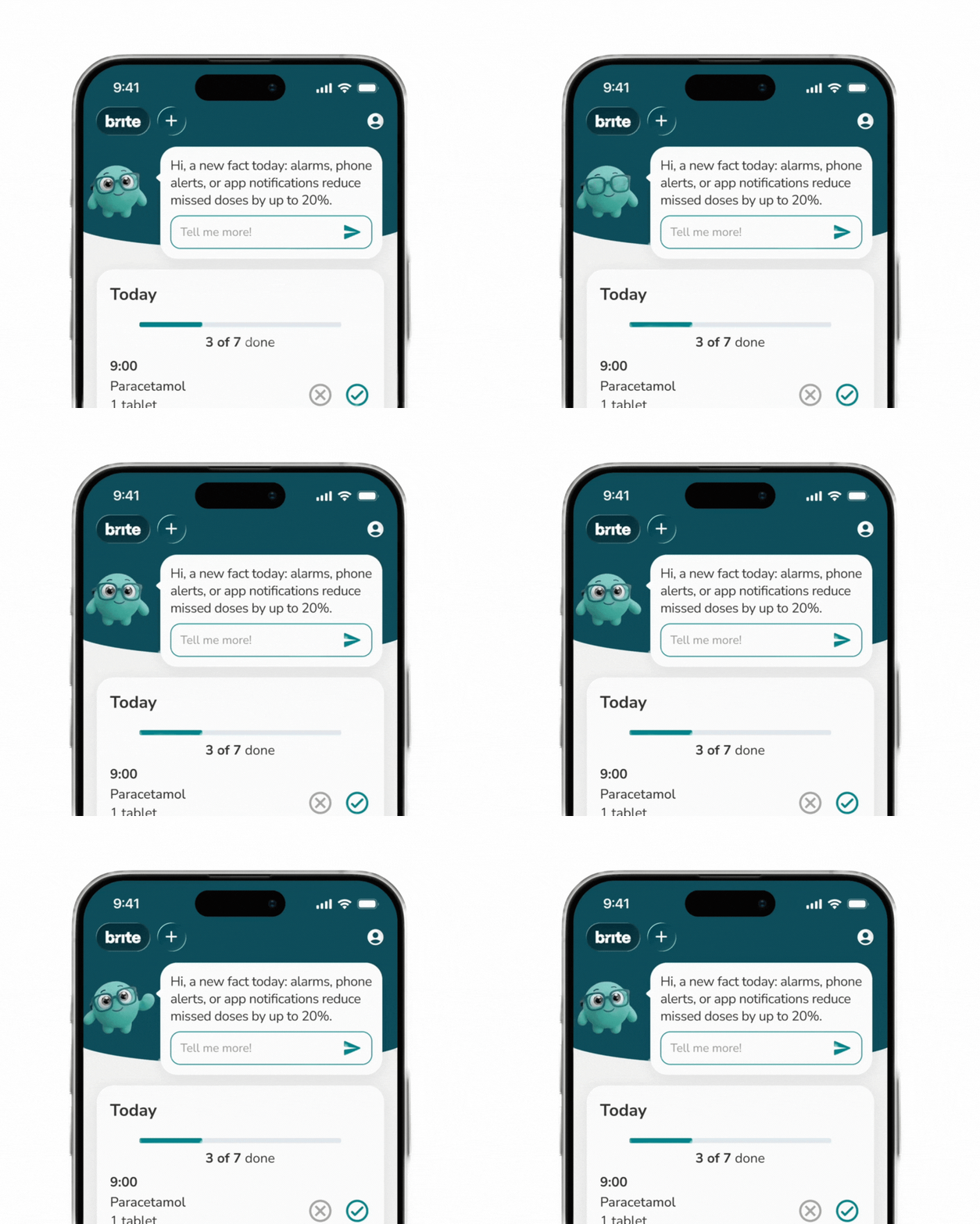
I finally understand my therapy. The app reminds me, answers my questions — and I don't feel alone with it anymore.
Moxonidine
Moxonidine: Don't Stop Abruptly — What Is Behind Rebound Blood Pressure
Moxonidine does not lower blood pressure at the heart or blood vessels but in the brainstem: it turns down the activity of the sympathetic nervous system, the “accelerator pedal” of the nervous system. In Germany it is not a first-choice medicine but an add-on and reserve option when other blood pressure medicines are not enough or are not tolerated. Important in everyday life: moxonidine is not simply left out but tapered over about two weeks, and it is off-limits in heart failure.
Centrally acting blood pressure medicine (antihypertensive), imidazoline receptor agonist
Dosage forms
Film-coated tablets of 0.2 mg, 0.3 mg and 0.4 mg
Half-life
Only about 2 to 3 hours in the blood according to the SmPC; it is excreted almost entirely via the kidneys
Maximum daily dose
0.6 mg, divided between morning and evening; no more than 0.4 mg as a single dose. With impaired kidney function, no more than 0.2 mg per single dose and 0.4 mg per day
Onset of effect
Highest blood levels after 30 minutes to 3 hours; a decision on any dose increase is only made after about three weeks each time
Prescription status
Prescription-only medicine
Notable feature
Do not stop abruptly; according to the SmPC, taper over about two weeks; contraindicated in heart failure, a very slow pulse and certain conduction disorders of the heart
Table scrolls to the right
2. How it works: the brake in the brainstem
Most blood pressure medicines act where the pressure is generated: on the blood vessels, the heart or the kidneys. Moxonidine acts further up the chain of control. In the brainstem, in what is known as the medulla oblongata, there is a centre that controls the sympathetic nervous system — the part of the nervous system that pushes up the pulse and blood pressure in stressful situations and narrows the blood vessels. Moxonidine binds there to special docking sites, the imidazoline receptors (I1 receptors), and so dampens the signals that travel along the nerves to the heart, blood vessels and kidneys. The blood vessels relax, the resistance in the vessels falls and blood pressure comes down.¹
Its older relative clonidine works in a similar way but acts more strongly on a second type of receptor, the alpha-2 receptors. The SmPC attributes the typical side effects of centrally acting blood pressure medicines to these receptors: drowsiness and dry mouth. Moxonidine binds to them only weakly.¹ This profile determines what moxonidine can and cannot do:
Strengths: it lowers blood pressure by a different route from ACE inhibitors, sartans, calcium channel blockers or water tablets (diuretics), and can therefore be combined well with them. It is regarded as largely metabolically neutral, which means that, as far as is known, it has little effect on blood sugar and blood lipids.
Weaknesses: it is not entirely free of central side effects — dry mouth, tiredness and dizziness are common, especially at the beginning. And because the nervous system adapts to the dampened control, the brake should not be released all at once (section 6).
Open question: according to the SmPC, the effects of moxonidine on mortality and cardiovascular events are not yet known. It has been shown to lower blood pressure — whether it prevents heart attacks and strokes as well as the first-choice medicines has not been proven.¹
Putting it in context. The German National Disease Management Guideline (NVL) on hypertension names ACE inhibitors or sartans, calcium channel blockers and thiazide diuretics as the first-choice drug classes. It lists centrally acting blood pressure medicines such as moxonidine among the further drug classes that are used later or in addition.² How this fits your high blood pressure is decided by the treating practice.
3. Dosing: small steps with waiting time
The following information describes what the SmPC provides for. It is not a dosing instruction — which dose suits you is set by the treating practice.¹
Start: according to the SmPC, treatment starts with 0.2 mg in the morning.
First step after about three weeks: if the effect is not sufficient, the dose can be increased to 0.4 mg a day — as a single dose in the morning or divided between morning and evening.
Second step after another three weeks: if the effect is still insufficient, up to 0.6 mg a day is possible, then always divided into two doses. The SmPC does not provide for more than 0.4 mg at once or more than 0.6 mg a day.
Impaired kidney function: because moxonidine is excreted via the kidneys, its level rises markedly when the kidneys are weaker. Lower upper limits then apply: 0.2 mg per dose and 0.4 mg per day, with a cautious start and close blood pressure monitoring.
Older people: with normal kidney function, no separate dose adjustment is needed according to the SmPC. But since kidney function often declines with age, it is worth looking at current lab values.
Children and adolescents under 16: not used, because there is not enough experience.
The three-week wait between steps has a reason: the body needs time to adjust to the lower blood pressure, and initial tiredness or dizziness eases off in many people. If you increase the dose too early, you may see side effects rather than an effect. A carefully measured blood pressure diary shows the practice after three weeks whether the next step is needed.
4. Taking it in everyday life
Moxonidine is straightforward in everyday life — as long as you take the tablets regularly. That is exactly where blood pressure medicines most often fail, because you cannot feel high blood pressure.
Choose a fixed time. With a single dose in the morning, with two doses in the morning and evening. According to the SmPC, it does not matter whether you take it before, with or after a meal; food does not change absorption.¹
Swallow with enough fluid. A glass of water is enough; it also helps with a dry mouth.
Measure your blood pressure regularly — especially in the first few weeks and after every dose change, ideally at similar times of day and sitting down after a few minutes of rest.
Get your repeat prescription in good time. An empty pack is the most common cause of unintentionally “stopping abruptly” — especially before holidays and bank holidays.
Driving and attention. The SmPC reports drowsiness and dizziness and urges caution when driving and operating machinery.¹ This applies above all at the start of treatment, after dose increases and in combination with alcohol or sedatives. More on this in the guide medications and driving.
Measure for three weeks, then decide
A blood pressure history with a dose log shows your practice at a glance whether the dose is right.
According to the SmPC, dry mouth, headache, weakness, dizziness and sleepiness are common, especially at the start of treatment. The frequency and severity of these complaints often decrease over time.¹
Common
Dry mouth: the only side effect the SmPC classifies as very common. Helpful measures are drinking regularly in small sips, sugar-free chewing gum or lozenges that stimulate saliva flow, and good dental care — saliva protects the teeth. More under dry mouth.
Tiredness, drowsiness, sleepiness: often in the first days and weeks; with a single morning dose, some people notice it during the day.
Dizziness: common as a result of the lower blood pressure, especially when standing up quickly. Get up slowly and sit on the edge of the bed for a moment first; more under dizziness.
Other common complaints: headache, sleep problems, nausea, constipation, diarrhoea, skin rash, itching and back pain.
Uncommon
Circulation: slowed pulse, a sharp drop in blood pressure including on standing, fainting, fluid retention.
Others: ringing in the ears, nervousness, dry or burning eyes, neck pain, allergic skin reactions.
The SmPC also lists side effects without a precise frequency, including depression, anxiety, loss of libido and impotence, gynaecomastia (breast enlargement in men), circulatory disorders such as Raynaud's syndrome, and problems passing urine.¹ Many of these complaints also have other causes — erectile problems in particular are common in high blood pressure itself. Raise them rather than secretly leaving out the tablets.
When you need help immediately. Swelling of the face, lips, tongue or throat with shortness of breath may be angioedema — call 112 (emergency number in Germany) immediately. The same applies to fainting, a very slow pulse with dizziness, or chest pain. If someone has taken a larger amount of moxonidine — for example a child who got hold of the tablets — likewise call 112 immediately: according to the SmPC, there is then a risk of severe sleepiness up to unconsciousness, a drop in blood pressure, a slow pulse and breathing problems. Advice in the guide medication overdose: what to do.
6. Don't stop abruptly: what is behind rebound blood pressure
“Rebound” means bouncing back: if the effect of a medicine suddenly falls away, the body overshoots its starting level. Among centrally acting blood pressure medicines, this phenomenon is known above all from clonidine. After stopping abruptly, the sympathetic nervous system, which has been dampened for a long time, can overreact — with a racing heart, restlessness, sweating and blood pressure that can be well above the level before treatment.
And with moxonidine?
Here an honest look at the SmPC pays off. It states that in a limited number of studies, no counter-regulation of blood pressure (rebound effect) was found after moxonidine was stopped. Nevertheless, it recommends not stopping moxonidine suddenly but tapering it over a period of two weeks.¹
The two fit together. The body of studies is thin, and in practice situations occur that studies hardly reflect: high doses, a combination with beta blockers, several missed days in a row. On top of that comes a simpler effect: if you leave out moxonidine from one day to the next, you lose the lowering of blood pressure. Blood pressure rises back to the level that made treatment necessary — and with severe high blood pressure that alone is a risk, even without any “overshoot”.
The rule of thumb. Even though a pronounced rebound has not been proven for moxonidine so far: treat it as if it existed. Stop only after discussing it and step by step — that is what the SmPC says, and it also avoids the other risks of a sudden rise in blood pressure. The guide stopping medications explains the basics.
Special case beta blockers: the order matters
Many people take moxonidine in addition to a beta blocker such as bisoprolol or metoprolol. If both medicines are to be stopped, the SmPC prescribes a fixed order: first taper the beta blocker gradually, and only a few days later moxonidine.¹ The background is the pattern known from clonidine: if the central brake falls away while the beta blocker is still acting, the blood vessels can be narrowed more strongly under the influence of stress hormones and blood pressure can rise more sharply. The National Disease Management Guideline explicitly names this order for clonidine.²
How a planned stop works
Clarify the reason. Side effects, well-controlled blood pressure after lifestyle changes or a switch to another medicine? The plan looks different depending on the reason.
Plan a replacement. Usually the rest of the blood pressure treatment is adjusted first so that no gap arises.
Put the reduction plan in writing — which dose from which day, spread over about two weeks.
Measure daily during this time, morning and evening, and note down the readings.
Know the warning signs: severe headache, racing heart, restlessness, sweating or markedly rising readings — in that case do not reduce any further, but inform the practice. Very high readings with chest pain, shortness of breath, visual or speech disturbances are an emergency for 112.
Unplanned interruptions, by the way, rarely happen on purpose; they come from everyday life: a hospital stay, a stomach bug with vomiting, an empty pack on holiday. If you know that moxonidine should not simply be paused, you can ask in good time in such situations.
7. Interactions
Moxonidine is hardly broken down in the liver; it is mostly excreted unchanged via the kidneys. Classic enzyme interactions therefore play a minor role. What matters most are combinations that lower blood pressure further or increase the dampening effect on the brain.¹
Can weaken the effect of centrally acting blood pressure medicines; conversely, moxonidine can increase their dampening effect
Not recommended according to the SmPC; discuss an alternative with the practice
Sedatives and sleeping pills, e.g. lorazepam and other benzodiazepines
More tiredness; the impairment of thinking and reactions caused by lorazepam is moderately increased
According to the SmPC, avoid using them at the same time; if unavoidable, only after a doctor has weighed it up
Alcohol
Increased tiredness and lowering of blood pressure
Go easy, especially at the start and before driving
Other active ingredients that are actively excreted via the kidneys
According to the SmPC, interactions in excretion cannot be ruled out
Show your complete medication plan with every prescription
Tolazoline (a rarely used vascular medicine)
Can weaken the effect of moxonidine in a dose-dependent way
Point out moxonidine in hospital
Table scrolls to the right
Two combinations deserve particular attention. The first concerns anything that makes you tired: sleeping pills, sedatives, some antidepressants, older-generation antihistamines and alcohol. Each may seem harmless on its own, but together with moxonidine the dampening adds up — with consequences for your ability to react and your risk of falling. The guide medications and alcohol sets out the basic rules.
The second is multi-drug blood pressure treatment. Moxonidine rarely comes alone; it is usually the third or fourth medicine on the plan. Every new prescription — even a medicine for prostate problems or one for erectile dysfunction — can lower blood pressure further. A complete medication plan and an interaction check before every new medicine make such overlaps visible.
8. Moxonidine in the treatment plan: a reserve medicine with clear limits
Moxonidine has been licensed in Germany for many years and is widely used — yet it is not a medicine for starting blood pressure treatment. The National Disease Management Guideline on hypertension relies on ACE inhibitors or sartans, calcium channel blockers and thiazide diuretics, because there are data for them on hard endpoints such as heart attack, stroke and mortality. The group of centrally acting medicines — the guideline names alpha-methyldopa, clonidine and moxonidine — appears there among the further drug classes for special situations; among the common undesirable effects, the guideline names water and salt retention.²
Active ingredient (group)
Role according to the guideline
Typical strength
Typical drawback
ACE inhibitors / sartans
First choice
Good evidence, also protect the heart and kidneys
Dry cough (ACE inhibitors), rise in potassium
Calcium channel blockers
First choice
Effective, metabolically neutral
Ankle oedema
Thiazide diuretics
First choice
Good efficacy, inexpensive
Shifts in salt and potassium
Moxonidine
Further drug class, add-on
Different point of action, combines well, little effect on metabolism
Dry mouth, tiredness; no evidence of fewer heart attacks or strokes; off-limits in heart failure
Clonidine
Further drug class, add-on
Also known as an emergency and hospital medicine
More sedating, pronounced rebound risk
Table scrolls to the right
Why heart failure is a hard limit
In heart failure, the sympathetic nervous system is permanently overactive. Dampening it with moxonidine seemed an obvious idea. However, a large study of a prolonged-release form of moxonidine in heart failure was stopped early because more people died in the moxonidine group than on placebo.³ Since then, the SmPC has listed heart failure as a contraindication.¹ To put it honestly: the study used much higher doses than are usual for high blood pressure. The lesson still stands: if you take moxonidine and develop heart failure — recognisable, for example, by increasing shortness of breath on exertion, coughing at night when lying down or swollen legs — you should have it checked by a doctor promptly. The medicine is then not simply left out but switched in a planned way.
Other contraindications affecting the heart
According to the SmPC, moxonidine must also not be taken in sick sinus syndrome (a disorder of the heart's natural pacemaker), second- or third-degree AV block (impaired conduction between the atria and ventricles) and a resting pulse below 50 beats per minute. Particular caution is needed in first-degree AV block, severe coronary heart disease or unstable angina pectoris, because experience is limited.¹
9. Special situations: kidneys, heart, older age, pregnancy
Impaired kidney function: moxonidine is excreted almost entirely via the kidneys. Even with moderately impaired function, the amount in the blood rises markedly. That is why lower maximum doses and a particularly cautious start apply.¹ In chronic kidney disease, current kidney values belong in every dose decision; more in the guide medications in kidney and liver impairment.
Older people: dizziness on standing up, tiredness and the combination with other dampening medicines increase the risk of falls. Getting up slowly, a night light on the way to the toilet and regularly checking whether all blood pressure medicines are still needed all help. See also medications in old age.
Low blood pressure: readings that fall too low during treatment often show up as dizziness, weakness or blacking out when standing up; more under low blood pressure.
Pregnancy: according to the SmPC, there are not enough data; moxonidine should only be used if clearly necessary.¹ For pregnancy there are better-studied blood pressure medicines, which embryotox names as the medicines of choice.⁴ If you become pregnant on moxonidine or are planning a pregnancy: do not stop abruptly, but discuss switching with the practice promptly.
Breastfeeding: moxonidine passes into breast milk. The SmPC advises against its use; if it is essential, breastfeeding should be stopped.¹
Lactose intolerance: many products contain milk sugar. In the rare hereditary galactose intolerance or severe lactase deficiency, a change of product may be necessary; in ordinary lactose intolerance, the amount is usually not a problem — if in doubt, ask at the pharmacy.
Operations: before planned procedures, moxonidine belongs in the conversation with the anaesthetist. Whether it is taken on the day of surgery is decided by the team — leaving it out unnoticed for several days should be avoided. See medications before surgery.
10. Moxonidine experiences: what patients really ask
“My mouth is constantly dry. Do I have to live with it?”
Not necessarily. Dry mouth is the most common side effect of moxonidine and becomes weaker in many people over the first few weeks. Until then, small sips of water throughout the day, sugar-free chewing gum and thorough dental care help, because less saliva favours tooth decay and gum problems. Also check whether other medicines on your plan dry out the mouth — some antidepressants, bladder medicines or antihistamines do this too. If the dryness remains distressing, a different blood pressure medicine is a legitimate option. Raise it rather than leaving out tablets.
“My readings have been good for months. Can I leave out moxonidine?”
Good readings are often precisely the result of the treatment — not proof that it is unnecessary. However, if you have lost a lot of weight, move more, drink less alcohol or eat less salt, a reduction may be realistic. The way there leads through the practice: together you decide which medicine is reduced first, and moxonidine is then tapered over about two weeks while you measure regularly. The guide lowering blood pressure naturally offers ideas for the lifestyle part.
“I forgot moxonidine for three days on holiday. Is that dangerous?”
If you feel well and your blood pressure has not got out of control, the gap is usually not an emergency. Take the tablets again at the next usual time in the prescribed dose — not a double dose. Measure more often over the following days and mention the break at your next appointment. With severe headache, a racing heart, chest pain or visual disturbances, on the other hand: have it checked by a doctor, and with chest pain or neurological symptoms call 112 immediately. For the next trip, a reminder that goes off reliably in a different time zone helps.
“Why do I get moxonidine and not simply more of my other medicine?”
With many blood pressure medicines, increasing the dose mainly increases the side effects, while the additional effect gets smaller. Combinations of medicines with different points of action therefore often lower blood pressure more effectively and with better tolerability. Moxonidine offers such a different point of action. It can also be a solution if first-choice medicines are not tolerated. Feel free to ask what the reasoning behind it is in your case — that helps you to support the treatment.
Four blood pressure medicines, three practices — does it all fit together?
The interaction check reviews your whole list, including sleeping pills and as-needed medicines.
No. According to the SmPC, moxonidine should not be stopped abruptly but tapered over a period of about two weeks. A pronounced rebound effect has not been observed in the limited studies so far, but without a plan blood pressure will at least rise back to its old level. The reduction plan is set by the treating practice.
Both lower blood pressure via the brain. Clonidine acts strongly on alpha-2 receptors, which are held responsible for tiredness and dry mouth, while moxonidine preferentially targets the imidazoline receptors. That is why moxonidine is regarded as somewhat better tolerated. The rebound risk after stopping suddenly is well described mainly for clonidine.
Often, especially at the start of treatment. According to the SmPC, tiredness, drowsiness and dizziness often ease off over time. Alcohol, sleeping pills and sedatives can increase the tiredness, and caution is needed when driving, particularly at the beginning.
According to the SmPC, treatment starts with one dose in the morning. At higher doses, the daily amount can be divided between morning and evening; from 0.6 mg a day, dividing it is mandatory. Whether you take it before, with or after a meal does not matter — what matters is a fixed time.
No, according to the SmPC heart failure is a contraindication. In a large study in heart failure, more people died on a prolonged-release form of moxonidine than on placebo. If you notice signs of heart failure on moxonidine, such as increasing shortness of breath or swollen legs, you should have it checked by a doctor promptly and not leave out the medicine on your own.
Regular small sips of water, sugar-free chewing gum or lozenges and good dental care. In many people the complaints become weaker after the first few weeks. If they remain distressing, the practice can consider a different blood pressure medicine.
Moxonidine can increase the effect of alcohol, and tiredness and dizziness then get worse. Small amounts now and then are usually not a problem once your dose is stable, but you should avoid alcohol before driving and at the start of treatment. Regular drinking also raises blood pressure in its own right.
Summary of Product Characteristics (SmPC) for moxonidine (e.g. Moxonidin STADA 0.2 mg/0.3 mg/0.4 mg film-coated tablets, as of November 2021; other products have the same content) — German source. fachinfo.de
German National Disease Management Guideline (NVL) on hypertension, long version 1.0 (German Medical Association, National Association of Statutory Health Insurance Physicians, AWMF; AWMF reg. no. nvl-009, 2023) — German source. leitlinien.de
Cohn JN, Pfeffer MA, Rouleau J et al.: Adverse mortality effect of central sympathetic inhibition with sustained-release moxonidine in patients with heart failure (MOXCON). European Journal of Heart Failure 2003; 5(5): 659–667. pubmed.ncbi.nlm.nih.gov
Embryotox — German pharmacovigilance and advisory centre for embryonic toxicology (Charité Berlin): moxonidine and high blood pressure in pregnancy and breastfeeding. Accessed 2026. embryotox.de
Stay on top of your blood pressure treatment — with brite
Dose reminders, blood pressure history, a tapering plan and an interaction check in one place. Free.
Medical disclaimer: This article is for general information and does not replace medical advice, diagnosis or treatment. Do not stop moxonidine abruptly, but only according to a plan set by your doctor over about two weeks; if you also take a beta blocker, that is reduced first. If you have swelling of the face or throat with shortness of breath, fainting, chest pain or very high blood pressure with visual or speech disturbances, call 112 (emergency number in Germany) immediately. The choice of medicine and the dose are always set individually by the treating practice. Last updated: October 2026.